Publication 5 of 2026
I think the world – not just Ireland – needs Irish. It is so breathtakingly beautiful.
Introduction
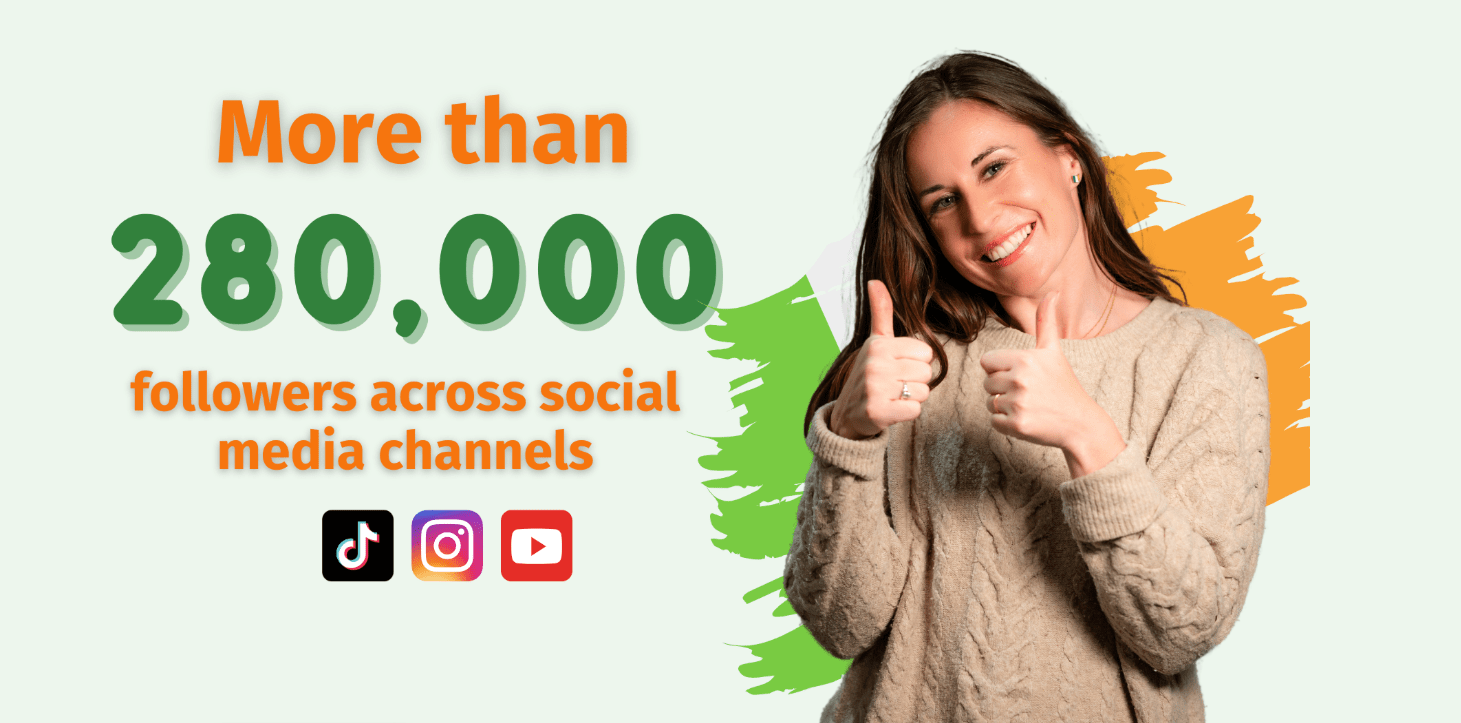
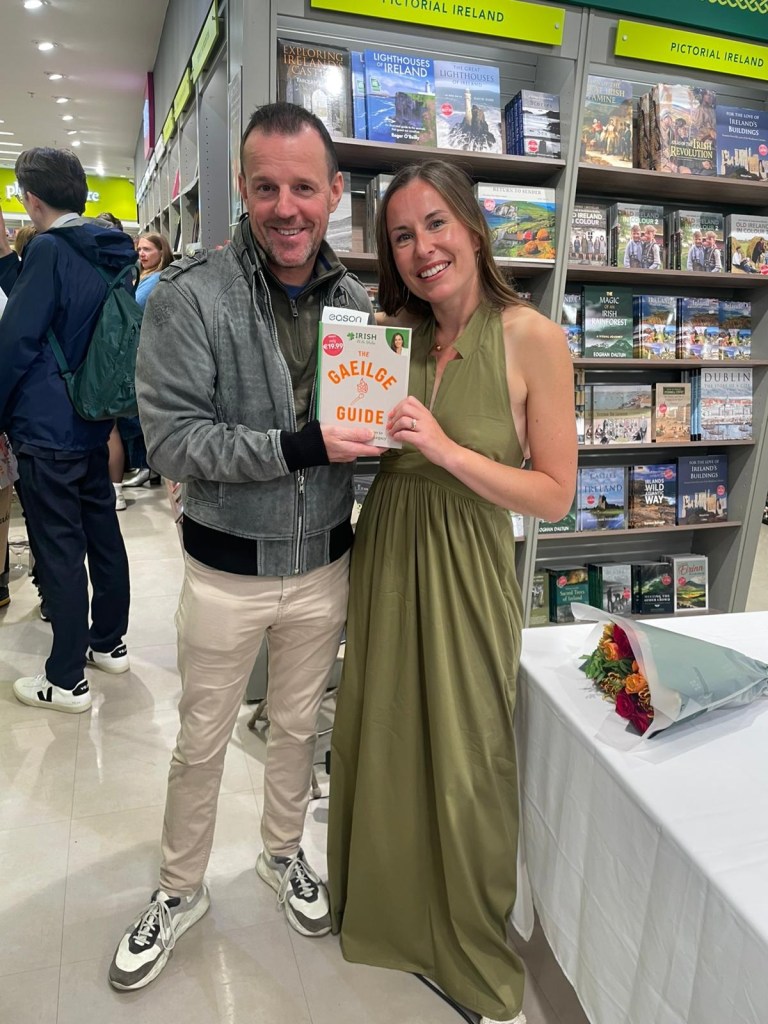
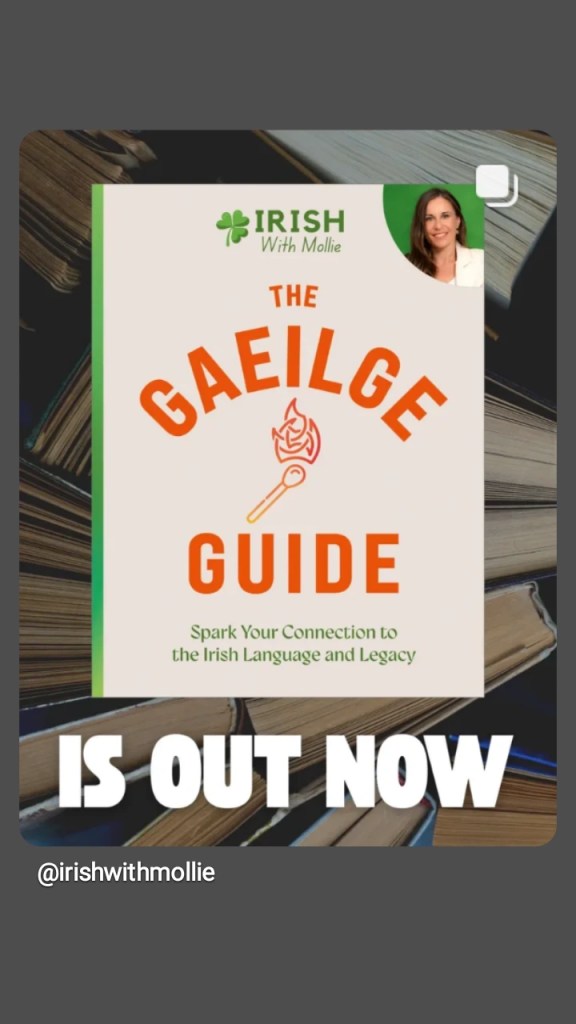
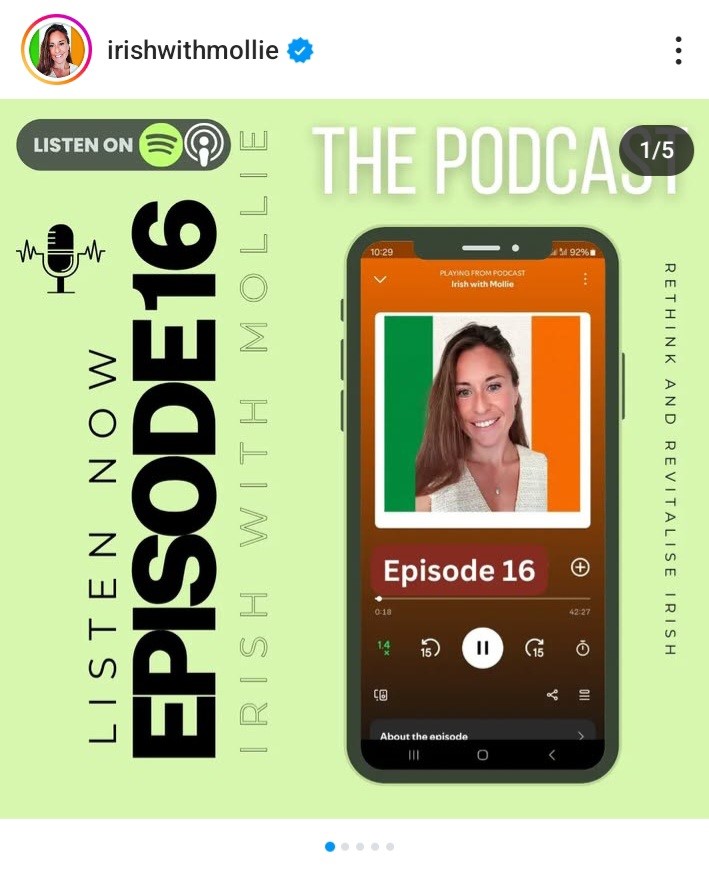
Since I recorded my interview with Mollie Guidera last year, she has not stood still! Mollie launched her book, The Gaeilge Guide, in September, and it was nominated for the An Post Irish Book Awards in The Last Word Listener’s Choice category. Mollie has now published 40 episodes of her podcast, and on the likes of TikTok and Instagram, her @IrishWithMollie accounts have about 300,000 followers. Mollie is an educator who has taught Irish (and English) and has designed an online course that she believes is suitable for all kinds of learners. Mollie believes in working towards a bilingual Ireland! Enjoy the interview!
…people can become fluent in Irish much quicker than in English.
Continued from Part 1…
Irish Language Matters (ILM): Is there a danger that people can get stuck in learner mode and become dependent on the tutor, their class, and the contacts that they make there – and I do think that’s important and that is part of their real lives and their lived experience – but is there a danger that they don’t get to integrate that part of their lives with their wider social lives?
Mollie: I have always tried to create autonomous learners and I joke that I’m creating a massive community of assistants or teachers. It’s not really a joke because the next step would be an academy of teachers. People are learning very fast and very well, and they’re able to answer each other’s questions. So I don’t actually need to be there as much as I used to because people are just accelerating their progress.
One risk could be because people love it so much. People are really in love with our community and actually falling in love with each other sometimes, and making friends and pen pals and all this. Maybe they’re keeping it a secret from their friends. You know sometimes if you have a hobby, and you’re like “These are my friends from kayaking or whatever, and I don’t want to introduce them to my husband (or whatever), because this is my thing and me time”. But I think it’s great that people are setting up their own Ciorcal Comhrás. They’re bringing it into the wider world. They’re setting up merchandise companies, they’re becoming teachers, using more Irish in the workplace or with their families. I think it’s like buds blossoming. One of the questions at the start was “Is this too much online? Is it really having an impact in the real world?” And it is. You have these walking clubs in Irish. People say, “Because of your course, I felt really confident and I was able to use my Irish with other people. Now I have new friends.” I love to hear that.
ILM: Have people really met partners at the classes?
Mollie: Yep! A few couples. I don’t think we’ve had our first Irish With Mollie baby yet, but a few people have fallen in love!
It’s not just ‘Mave’, like ‘pave’ (a street) in English. It’s Méadhbh, and you can hear those inflections.

ILM: Do you think Irish people that don’t speak Irish – especially critics – and I think it’s less prevalent in mainstream discourse and social circles, you don’t see the kind of toxic, aggressive, anti-Irish rants that you might find on microblogging sites. But for people who are critical of Irish maybe, do you think they’re in a position to assess what they’re missing out on if they don’t have a knowledge of the language, the placenames, the names, the songs, the stories, the literature, and all the social experience that goes with that? You know, if I say, “I never spoke a word of Irish in my life and it didn’t do me any harm”? I sometimes think of someone who years ago said to me, “My Dad used to beat me as a kid, but it didn’t do me any harm”. Are you really in a position to assess that, you know?
Mollie: My God! Yeah, I think it comes from a deeply colonised mindset and an insecurity – a major insecurity – also a disobedience, a wilful luxuriating in ignorance; a wanting to not learn you know? And I think maybe we all have it. I know that sounded very judgemental. Like, I mean, I don’t really like golf and I wouldn’t really be interested in it. Maybe there are major fans and they’re like, “You have to try this, it’s life changing!” I would actually be open to going on a course and spending some time. I’m pretty open to those things, but I think people are pretty closed-minded about the language and I think it might stem from personal experience. Yeah, maybe having failed at school, or hated their teacher, or they really believed it was a waste of their time, or they had a negative experience with the community or some speakers. But I don’t think they’re in a healthy position to assess the value of the language, and I hope that’s changing and I think it is because we are seeing a huge cultural shift, and a growth in pride and passion and love for the language.

So, someone said to me recently, “I see these girls on TikTok doing ‘Let’s put on my make-up in Irish’ and I feel jealous, but in a good way, like inspiring jealousy like, “I really need to understand that, so I’m learning as much as I can to understand ‘what are they saying?’, ‘why is that funny?'” And these memes or music, like Kneecap has had a great effect in that way. People want to learn the lyrics. They want to know ‘what’s that word?’, ‘why is it pronounced like that?’ People need to catch up with what’s cool. At one stage it definitely wasn’t cool, and I think to distance yourself from that and see it for its integral value is important. So, I think it is changing, and people who used to complain about it are realising it’s not cool to complain about it anymore – it never was but definitely not now.
People say, “Because of your course, I felt really confident and I was able to use my Irish with other people...”
ILM: Yeah, that attitude seemed to get a lot more airtime – particularly in the print media going back maybe 10-15 years ago, but there’s probably less of it now. And obviously, we live in a free society, everyone’s entitled to have their opinion, but I sometimes wonder would people be given airtime if people said that they hated opera music or they hated art, do you know? It’s a bit like saying “I hate oil paintings”, do you know? Like, “I’m anti oil painting”. You’d just be laughed out of town if you said, “I’m anti-oil painting”, or anti Pop music, so the idea that you are against a whole language and everything that entails – to me that’s just bonkers if you look at it critically.
Mollie: Yep. Absolutely. I think it doesn’t deserve that kind of hate. Nothing does, and it makes no sense, like you say.
ILM: I’m with you on the golf by the way! What do you make of it when people say they want Official Irish to be made easier in order for it to be brought into the mainstream – that some of the grammar be rationalised to make it more learnable for the average Joe?
Mollie: Well, I don’t agree with the phonetic spelling of Irish. Some people think that would save time, but actually if I’m to write fáilte phonetically for me, you might not read it fáilte. And then do you make people learn the International Phonetic Alphabet? Like, I don’t think that makes any sense and it reduces the music of the language and then the nuances, and even the meaning. So, I don’t think learning Irish needs to be time consuming if it’s taught very clearly. If it’s taught very clearly and with energy, it’s a very logical, satisfying and consistent language. It is orthographically shallow, meaning the sounds are very consistent. You know, I also taught English for about 12 years and English is highly inconsistent, irregular and annoying to learn and teach and people can become fluent in Irish much quicker than in English. So, I think there are so many misconceptions and mysteries, and to demystify it is so important. Like, when people go “I can’t learn Irish because I have dyslexia.” Well, you learned English. You know? Or “I can learn other languages like French because they make sense” or “Irish isn’t written the way it’s spelled”. It is. And in a name like Méadhbh, you do hear the ‘dh’ and the ‘bh’, beautifully. It’s not just ‘Mave’, like ‘pave’ (a street) in English. It’s Méadhbh, and you can hear those inflections. So, I think it’s a case of loving the challenge and learning to engage with it and embrace the learning curve. People want things to be easy and convenient and comfortable but, come on, if you want to have a ripped body and feel good and do anything good for yourself like eat well and look after yourself, it takes effort and so does learning a language.
ILM: Yeah, 100%. Do you think Irish has more internal consistency than English would have because – you know the way English is like a magpie, it borrows from everywhere.
Mollie: Yeah, I think so. I also think that what people find difficult, it’s just not being explained very well, you know? People go “Oh, when you throw in a ‘h’, why does that happen?” Well, here’s a list of why that happens, and here are the letters it happens to. It’s not completely random – only 9 letters – here’s a mnemonic…Like, mnemonics are great. I think people then realise, “Oh, there’s a reason – there’s a connection with ancient Irish culture. OK, so Irish is not complicated. It’s our relationship with her that’s complicated, and we just haven’t had a meaningful, joyful response to that”.
ILM: That’s lovely, yeah. And I think that once people – as learners – get used to the phonetics and the fadas and the different sounds and all, that there is a lot of repetition and predictability and that in many ways reading Irish is actually predictable and straightforward. To a monolingual English speaker – and unfortunately many of us are when we finish our time in Secondary School – it may appear to be confusing and unpredictable. You see all these stupid memes on social media about Irish given names which are celebrations of ignorance, I think. I find it very frustrating when I hear people taking the piss out of our Gaelic names. They’re very important as part of our heritage.
I think if it’s taught in a good way, highlighting the beauty and relevance and wisdom of it, people will fall in love with it and want to protect it and want to speak it.
ILM: Can I ask you, in relation to the required subject at school…on the one hand people like Brian Stowell who was a key member of the Manx language revival in the Isle of Man, he felt that compulsion was the enemy and if you allowed kids to choose the Manx language, that they would be committed to that, and therefore you get a cohort of students that are motivated and in a much more positive environment. I can completely see why that makes sense. On the other hand, you have people involved in other language movements, and they say, “We envy what you do in Ireland” because, while the competence achieved at school might be low level, it’s widespread, and so many people in Irish society have a basic knowledge of Irish – they know it exists. So, these are two competing mindsets when it comes to the required element at school. Do you have an opinion on any of that?
Mollie: I don’t think there’s a…you know “Here’s the solution and this is definitely going to work”, but I agree with you, I think having it widespread, all the signs in Irish, having it in every school, putting an emphasis on it in Primary School is really great. I think it’s in Quebec with French that they just assume, “We’re bilingual, and we do things in French as well”. And whether you have any different learning need or any reason – maybe you just moved to Quebec aged 12 – you’re still going to learn French, and it’s going to be a fun and community language and loads of opportunities to use it and it’s taught very well. And people accept it.
Moving away from a colonised mindset
I think there’s such resistance to Irish because a lot of people don’t use it in their daily lives, so they don’t see the point or the value in it. I think if it’s taught in a good way, highlighting the beauty and relevance and wisdom of it, people will fall in love with it and want to protect it and want to speak it. So, I think that’s what should really happen. I think it is happening, and people are realising things about their own language that they never knew. People are like “Wow, that’s actually pretty cool!” They don’t know that Irish is interesting or beautiful or sounds nice, because they’re so brainwashed into thinking it’s backwards, and I think that the further we get away from a colonised mindset…the Republic is still relatively young and people are finally celebrating and reviving our own culture.
People are realising what’s important
You see people like David Keohan – you know with Celtic Stone Lifting, the GAA handball documentary, people getting more into knitwear. When I was a teenager, we drank blue WKD and watched Home and Away and now, maybe not teenagers – in fact, people are drinking a lot less – but people are drinking more Guinness and wearing Aran knitwear. There’s the hipster movement involved, there’s the pandemic influence – people realising what’s important – and I think a pride that’s growing there. But yeah, in terms of fostering a healthy attitude towards the language, I think reducing the stress…also the exam being so terrifying and so scripted really isn’t conducive to loving the language. You know, having to write an essay about social problems, that’s not what an 18-year-old wants to talk about and they could really do a better job if they just think about it.
Preparing students for connection
I remember preparing a student for the exam, and I was just interested like, “Oh, what did you do yesterday? And how did you make that?” and whatever, and they were like “Oh, is that question going to come up?” And I said, “I don’t know.” I think they follow a script, and this is two people having a normal conversation which is not what they are prepared for, which is very sad. So, I think if you’re preparing students for connection, that’s the main thing. And I think it can be done. If you look at the Basque Country, or even the revival of Hebrew, the revival of the Māori language in New Zealand – the different native American languages as well.
I don’t think this is a wave. I think this is a flood at the moment. I think waves have come and gone in the past but this is just gaining momentum.
ILM: I would be very dubious about the certain figures that are out there. The truer statistic might be Gaeltacht speaker numbers, as opposed to overall Irish speaker numbers. The reason I say that Mollie is that I’ve met people over the years who would have much better Irish than me, and their personal assessment (of their ability) is that they can’t speak a word of Irish. And then I’ve met people that literally can’t speak a word of Irish, and they say that they can speak Irish because they know some Irish, or they remember some Irish words. So, I think people are pretty bad judges at their own ability at language. My question is, with this positive wave of Irish language art, creativity, culture and passion towards the language in recent years, do you think that we are seeing a quantifiable uplift in usage in the community, or will that become apparent in the future or, as Bláthnaid Ní Chofaigh suggested recently in an interview, is this just a wave and we need the wave to fall away before we can tell what we’re left with?
…it’s a verb-first language and only 6.7% of the world’s languages are verb-first, that’s why we say, “Says she to me”, “Says I to her”.
Mollie: I don’t think this is a wave. I think this is a flood at the moment. I think waves have come and gone in the past but this is just gaining momentum. I think the world – not just Ireland – needs Irish. It is so breathtakingly beautiful. Loads of people you meet are just enamoured with it. People love the sound of Irish, the concept of the words and the diaspora is absolutely massive and I think it’s a beautiful way for people to connect and feel this resonance with their homeland. Irish people have traditionally been pretty mean to Irish American’s for example, not believing that they’re Irish; who are kind of mocking them for being so enthusiastic but I think what we need is enthusiasm and I like how I can straddle the different markets. Some people go “Oh, is this geared towards Americans?” No. I’ve maybe 35% of my students are Irish people living in Ireland and they connect very well with it but then they don’t know what level they’re at. They think they’re intermediate and then they realise “I have to go right back to the beginning because I don’t know what an urú is and I don’t really know what a masculine noun is.” It sounds like the nitty-gritty, and some people say, ” Just talk”, but people don’t feel comfortable just talking, they don’t want to make mistakes. They want to understand why is it like this? And why do we speak the way we do in Ireland? It’s all connected and it’s very interesting to know that because it’s a verb-first language and only 6.7% of the world’s languages are verb-first, that’s why we say, “Says she to me”, “Says I to her”. People love that. They’re like “Ah, so that’s why my Grandmother said ‘I’m only after doing this”, you know? They love these connections to syntax.
In terms of using it in the public sphere I think it is happening that you see more yoga classes in Irish, cookery classes in Irish around Ireland, different things happening and people actually committing to it. I don’t think it’s something that people are going to let go after it fades away. I don’t think it’s a fad.
ILM: I would be thrilled to think that that’s the case, and I do hope and believe that it is the case. Sin é. Tá gach ceist curtha agam. Táim fíorbhuíoch díot as do ama agus do phaisean don teanga chomh maith!
____________________________________________________________
Foilsithe Márta 2026
Buíochas ó chroí le Mollie! Tá Cuid 1 ar fáil anseo.
Thanks from the heart to Mollie. Part 1 is available here.
If you wish to give something small towards the cost of running the site, you can buy me a coffee – go raibh maith agat!
Follow Me
Get new content delivered directly to your inbox.
 Irish Language matters