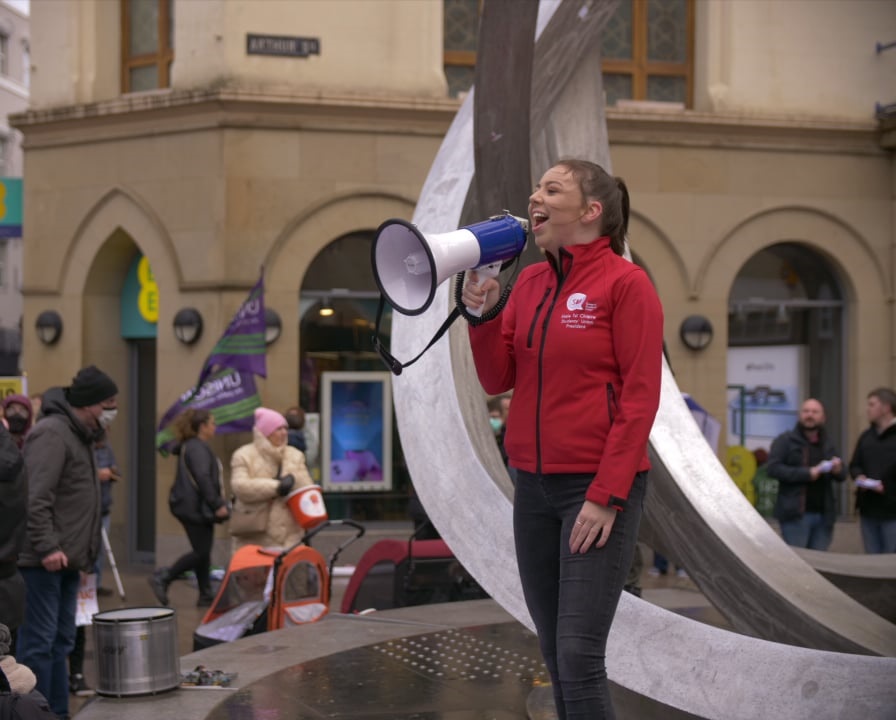
Q. Why does the Irish language matter?
A. It’s a big question. I think first of all it absolutely does matter. You said just before there the Irish language matters a lot to you – it matters a lot to me as well, you know I grew up with it. I spoke Irish as long as I can remember. I remember speaking Irish before I spoke English and you know, I think, for me, it’s part of my identity, my culture, my heritage and my history as well. And I think that it’s so important that it is given that special space, and a special status so that people can continue to learn, and learn how connected it is to the culture and world around us as well.
And it’s not just about Ireland. It has connections all across the world – how it links back and the origin of languages as well. It’s so important that we all have the opportunity to speak it where we can, and that it’s given its fair place in society.
Q. So you mentioned there that you remember speaking Irish before you spoke English, so it was obviously your home language, was it?
A. Yeah, so, I generally tend to think of it as my native language. I would have grown up with both. So my mum speaks Irish but my dad doesn’t so we would have had Irish in the house. I always remember learning poems and rhymes in Irish, songs in Irish and stuff like that. And then, when I was three years old, I went to my first primary – or my pre-school – which was a naíonra then. So from then on…. I’ve spoken it all that time and my siblings all speak Irish, and a fair few of my cousins would have went to the same preschool, primary school, secondary school as I did. So a huge amount of my family has Irish and speaks it. So the first time I learned and lived and studied through English was when I came to Queens in 2017. So the first 18 years of my life was primarily Irish-based.
Q. So you did your whole [Primary & Secondary] education through Irish, did you?
A. Yep, all of it – from pre-school right through ‘til my Leaving Cert. all through Irish, every step.
Q. So, from your background then you would have been a native bilingual, fluent in both languages growing up?
A. Yep.
I’ve met more and more Irish language speakers and Gaelgeoirí in Belfast … the opportunities for speaking Irish have definitely increased
Q. Fantastic, what a great advantage. So that’s where you got your grá for the language from. So, how often do you get to speak Irish, I suppose, em…you mentioned a lot of your family speak Irish so, when you are together would you be using Irish as the language of communication?
A. It kind of depends on the circumstances I think. Sometimes we do, sometimes we don’t. If we’re with extended family or kind of older family then we don’t because they wouldn’t have Irish. My opportunities for speaking Irish since I came to Belfast have definitely decreased. You know, I went from speaking Irish on a daily basis – either at home in the house or at school, like you’d be spending your whole 9-4 or whatever speaking Irish, speaking to your friends in Irish – and then when I came here it was strange to not hear that everywhere. I was the only person in my whole year of my Degree who had any level of Irish, and that was bizarre. But, I think the more work I do in this area, I’ve met more and more Irish language speakers and Gaelgeoirí in Belfast and that created…like, the opportunities for speaking Irish have definitely increased over the past year or so, I would say, because I’m working with those individuals on a regular basis.

I probably purposefully decreased my use of Irish then so that I wouldn’t get in trouble
Q. Have you noticed changes in use of the language, or I suppose attitudes towards the language, in your lifetime?
A. Yeah, well I suppose my journey has lead me through kind of different levels of understanding of the tolerance of Irish. So, obviously my whole growing up life – Irish was great. It was like, you know, it was unique to have it but all my friends had it because I went to school with these people, you know, and it was given, you know, such a high level of respect that if you were chatting to other people and you said that you were going to the Gaelscoil, people were like ‘Wow, that’s so cool’. So, I grew up with…I definitely took for granted what was around me and what was available in the Irish language that I could access. I could do my whole school years through Irish and that was never in question for me – that was always something I was going to do.
So, I think it was a bit of a shock to me when I moved to Belfast and began to learn more about the campaigns and the movement, you know, the lack of an Irish Language Act? You know, I heard that when I was home – didn’t fully understand it – and when I moved here I could really see the difference and the attitudes I experienced while here. You know the vast majority of people thought it was really cool and that it was amazing that I could speak Irish, but there were people that I met and ran into who really didn’t like that I spoke Irish – really thought that I was going out of my way to irritate them by using, like, the Irish language. Definitely in my first year here I would throw out phrases in the Irish language all the time because that’s what I was used to at home. I’d be leaving a shop and I’d say ‘Go raibh maith agat. Thank you.’ Or I’d be saying ‘See you later’, like ‘Slán’, stuff like that, and there were actually some people I knew at the time who actually gave out to me for that and said ‘Why are you trying to offend me?’ I was quite a naïve 18-year-old. I was very very shocked that that was a thing.
Now, that’s not something I’ve experienced in recent years but it actually hurt for that time. I probably purposefully decreased my use of Irish then so that I wouldn’t get in trouble. I didn’t understand fully why it was such a big deal. I was like ‘Oh God, I don’t want to annoy anyone’. But I realised I was never in the wrong there, but it was definitely a shock to the system.
I think over the last couple of years I’ve definitely seen more tolerance for the language here, especially in the student movement that I would work within. There’s a real emphasis on Irish and a real willingness to learn and engage in the issue from members of all different communities. And it’s been really great to see that grow and flourish but I still would regularly encounter a lot of hate for my use of the language and anger, again the same kind of attitude that there’s a perception that I’m going out of my way to offend people because of my use of a ‘cúpla focal’. Recently, there was an incident where I used ‘Athbhliain faoi mhaise daoibh’ in a Student Union email that I did just after Christmas, and suddenly I was public enemy no. 1 for a group of people who then went out of their way to contact me, harass me for that use, post on anonymous forums about me, saying that I was going out of my way to aggravate members of the Queen’s community which I found was really hurtful, when all I wanted to do was wish students a Happy New Year. So, you know, it is shocking that there’s still people with those attitudes in this day and age but I do see that changing. I can see it changing even in political leadership. There’s a lot more tolerance there now, but it’s definitely not where it needs to be yet.
What I really love to see is when international students get really stuck in to it…
There’s an element of me – and I do think of these things carefully and purposefully as well especially when it comes to my work – that I am using my cúpla focal in a way that I know is thought through and measured and that…you know? But it’s going to provoke a response no matter what I do. But I think it’s so important for the visibility of the language that I do that, and it’s really important to me and to who I am that I’m able to do that and show my second language. It’s a language I speak. It’s definitely challenging to navigate that and to have those really difficult conversations particularly with people who would get in touch with me and have no intention of changing their mind and who aren’t open to hearing the reasons why I included it. So there’s definitely been a few interesting email conversations with some students about that. I think the vast majority of students are very supportive of it and I think it’s great to kind of see that.
What I really love to see is when international students get really stuck in to it because there’s always this perception of…you know, I’ve been told multiple times ‘Well, you used Irish – why didn’t you use Polish?’ or ‘Why didn’t you use Chinese. Like, we have Chinese students in the University?’ and I’m like ‘Yeah, we do. We do have Chinese students and Polish students, and all these other international students, and fantastic, and let’s support them to celebrate their culture in the way that they see fit’. But for me, I think including a couple of lines of their language that I don’t speak in an email would be nothing more than tokenistic, and would actually cause actual offense, because I’m not doing that for them, I’m doing that to, you know, I don’t know – I wouldn’t do it – what’s the point? I think getting that kind of attitude back but then seeing international students come out and say ‘Actually, I really loved to see that because that’s the culture I came here to experience, and that’s what I would like to see. I would like to see the University and the broader community celebrate the Irish language and the Irish culture more’.
As with any other local cultures, they would like to see that promoted more instead of hidden away of dampened down. Like, let’s celebrate all of them and let’s give people the space to do that instead of attacking people for doing it.

Q. And would you be conscious then, I suppose, of your leadership role in that and, you know, from the point of view of other Irish speakers or learners that, when you make Irish visible like that, that gives them a great sense of…I don’t know if pride is the right word but…it makes them feel included I suppose?
A. Yeah, and I think that’s part of my responsibility to do that when I’m in this job. There’s a lot of things I do for all different reasons. The Irish language is the one we’re talking about today but it’s important that people see that there’s…again it’s challenging those narratives around ‘dead language’. It’s not a dead language. It’s a language that I use on a regular basis so I’m going to put 4 words of it in my email to demonstrate that. It’s to show people that this is a visible language, this is something that we should all be a lot more accepting of, and the vast majority of people actually love it – they love to see it and they really appreciate that someone has made that effort there and not shied away from the issue or hidden away from it like we so often do in the North.
Q. Have you thought about a career in politics after you’ve finished your studies?
A. [Laughs] People ask me this all the time. I don’t think so. Not straight away anyway. If I were to revisit in a couple of years I might think differently but definitely not for the time being. My family keeps asking ‘What are you doing next?’ It’s been an incredibly intense year, incredibly difficult in so many ways that, personally, there’s only so much resilience that I have for the kind of level of harassment that I’ve faced at times. So, I’m going to take a break and see. [Laughs]
…there’s a lot more Irish speakers at Queen’s than anyone accepts, or that anyone believes.
Q. Prior to Covid, how would you have described the Irish language social scene in Queens, or even in Monaghan? Like, you know, outside your family would you have social opportunities for using Irish?
A. Yeah, well I suppose I’ll maybe talk about Queens first. All those opportunities in the University come from the work of the Cumann Gaelach. So, that’s the Society that looks at the Irish language here, and they do so much incredible work in terms of campaigning, lobbying, just general activism. And then they provide like events: pop-up Gaeltachts, stuff like that. So, I was pretty aware of their work for the first year that I was here but then once I came over and started getting to know their staff it was great ‘cause there’s a lot more Irish speakers at Queen’s than anyone accepts, or that anyone believes. And it’s great that everyone comes together. It’s a really tight-knit community and I’ve had a lot of really great friends within that community. Everyone just seems to be really willing to help each other out. Like, they’ve helped me with my elections to be in the SU. I’m going to help with some of their elections for this year and it’s really great to have that kind of support and that mutual understanding of like, ‘Yeah, we all go through this all the time – where we can’t do what we’d like to through the language that we love,’ so I think that there’s great community there.
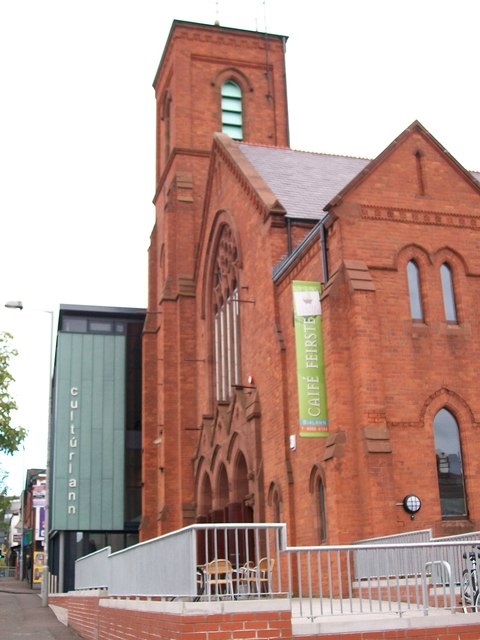
Everything I did when I lived in Monaghan would have always been through school, and everything I did through school was in Irish.
Everything I did when I lived in Monaghan would have always been through school, and everything I did through school was in Irish. It wasn’t as such a novelty or something I sought outside school ‘cause it was just the norm. But definitely, there’s a group called Muineachán le Gaeilge that are doing amazing work. There’s a really strong network of Gaeilgeoirí in Monaghan – like, I’d still know loads of them. There’s a couple of individuals doing work with TG4 and with other Irish-language media for Monaghan and it’s good to see. Like, you do begin to know almost every Gaeilgeoir on the Island [laughs] that are involved in any kind of activism like, it’s a very close-knit community I think but, it’s so lovey as well.
Q. I’m kind of sorry to hear that you mentioned that you wouldn’t be interested in – not that it’s any of my business or anything – in public life because of the experience you had in your position. That’s kind of sad isn’t it, that you would need a break because you received so much harassment like? There needs to be space for new leaders and new ideas coming through and it would be a real shame if we lost people who could be potential leaders of the future because they were shouted down when they tried to be a voice for minorities and things like that – that would be a real shame.
A. It’s definitely really like I think, you know, I think quite common in the Students’ Union generally, like the level kind of…you know, people do see a public figure, and when people see a public figure, they’re so detached from them as well. And I think that’s how a lot of students, a lot of the broader public…you know, there’s a very big lens on Queen’s and Queen’s Student Union generally. If we do anything it can make newspapers which again is quite unique. That wouldn’t be the case for most student unions across the UK or Ireland but we are quite unique in that sense. So, we’ve got all that extra pressure on top of being viewed as a public figure. People think that they can kind of say what they want about you. They don’t view you as being really a real person sometimes, which is bizarre because actually, I go to all the same pubs as all the students, I walk the same halls, I have the same teachers. I’m the same age as the people I represent, like, they are my peers that I represent in the end of the day. It’s bizarre sometimes what I feel when people email me or post about me online is that they completely forget that I’m an actual human being. And as well, there’s additional challenges with being a young Irish woman who also speaks Irish regularly in Queens. It creates a really challenging environment. People perceive it to be something that they should challenge. I think the experience I’ve had, the experience of some members of my team, em…I’m quite loud on progressive issues you know? I’m an abortion rights activist, feminist – these things as well that people do take issue with as part of the misogyny – and my team as well, very strong abortion rights activists on my team as well who would get that kind of hate and attention too and it’s really really difficult…it creates a really difficult time for us and you do get to the end of it and say ‘Actually, I would like a break and I would like to become irrelevant for a while and I would like for people to realise that I’m real, I’m not just the face on the email that you see.’ It can be really hard.

Q. Can I ask you in relation to the University, what’s the latest in relation to bilingual signage on the campus?
A. So, the University is still continuing to refuse to implement bilingual signage on campus. This has been an on-going challenge for decades now I would say. There used to bilingual signage in the old Students’ Union building, and in the late ‘90s that signage was all removed and taken down because it was viewed to be offensive. Since then, there has been ongoing campaigns from Irish-speakers to reintroduce those signs. Those campaigns have not yet been successful to date. The University continues to say that they have no legislative basis to implement signage.
There was a letter at one stage where one of the senior managers at the University at the time, who is no longer in the University, said that the language was provocative, offensive and intimidatory. And this was in about 2017, and this was used as the basis to not implement bilingual signage. I remember seeing that online and saying ‘Wow, this University that I’ve just joined feels that my language and my culture is offensive, intimidatory and provocative then: What?! Why? Is that really a fair thing to say?’ Because, at the end of the day, it’s a denial of human rights. I do feel that there is being progress made at the moment on Irish language issues, but the real test will come if, and when, we get an Irish Language Act. That’s when we will have a stronger basis to go back to the University to say ‘Well, there is legislation now that dictates that you should do this, so you have your basis and your foundation to do this now’. And we’ve been told all along that that’s what will happen when we get an Irish Language Act. I think it should have happened a long time ago but, that’s when the real test will be for the University, if they’re going to stick to their word on that.
The language has been weaponised. Do I believe that university senior managers have such a strong hatred for the language that they don’t to introduce signage? No. But do I think that they are under significant pressure from certain political leaders? Yeah, and I believe that that’s where the issue is coming from; that they’re refusing to take action on the basis of the backlash from some key figures in the Executive would be too much for the University, and it would reputationally be damaging if it were to get that hit from certain political leaders. But again, I disagree, I don’t think it’s a good enough reason not to comply with human rights and language rights, but that’s where we are currently. We’ll definitely see what happens over the next while and if we can get an Irish Language Act within the next while.
[Regarding the cost of signage] There’s a new Students’ Union Building being built at the moment – part of it is Students’ Union but it’s a university-owned building. We are not allowed to put bilingual signage up in that building. If we were to – because all new signs, all new everything going up – it would cost minimal extra to add the Irish language stuff to the design process and it would cost minimal extra for signs because you are ordering in bulk anyway. So the actual cost of adding it would be next to nothing in the grand scheme of how much the project is costing anyway, and actually it would make the world of difference and be there for what? Another fifty years? So, it’s such a poor argument and if they can do it in the South…where are people in the South complaining that their signs have too many words on them? They’re not.
Q. Are you hopeful that language rights will be forthcoming?
A. Yeah. I’m definitely hopeful. I think it will happen. I think it’s inevitable that we get an Irish Language Act and that the Irish language will get the rights that it deserves. The Irish language has even stronger status within the EU now which is ironic – that Brussels gives more rights to the Irish language than Belfast does, but I do think that we’re heading in that direction. I think the more conversations that we have, and, you know, the further people come along on that journey; and with the political landscape in Northern Ireland just generally changing and really shifting to be a lot more progressive, I think that we definitely will get there. I think it will just take time. It’s incredibly disappointing as someone who’s been an activist in this sphere and has seen the likes of An Dream Dearg and Conradh na Gaeilge doing so much work on this, it’s disheartening to see it constantly being promised and pulled away, and promised and pulled away. I remember the night that New Decade New Approach was signed and it was on the TV and was a really great deal and we were so excited that finally this was written into provisions only to be now 2 years down the line and no sign of it, for Westminster to have made empty promises about October time, which is now 4 months ago [interview date 31/01/2022] and for certain parties in the Executive to say they’re going to pull down the Executive and collapse the Government if it gets introduced by Westminster. So, it’s disheartening but I do have hope.
I see more and more people constantly, you know, my friends always say to me ‘Will you teach me Irish?’ They’re really trying to learn, trying to use their cúpla focal in the end of emails, asking for translations for things that they’d like to use the cúpla focal now and then, and I think it’s really amazing to see that – the people from all over just trying and wanting to do their part in this greater journey as well.
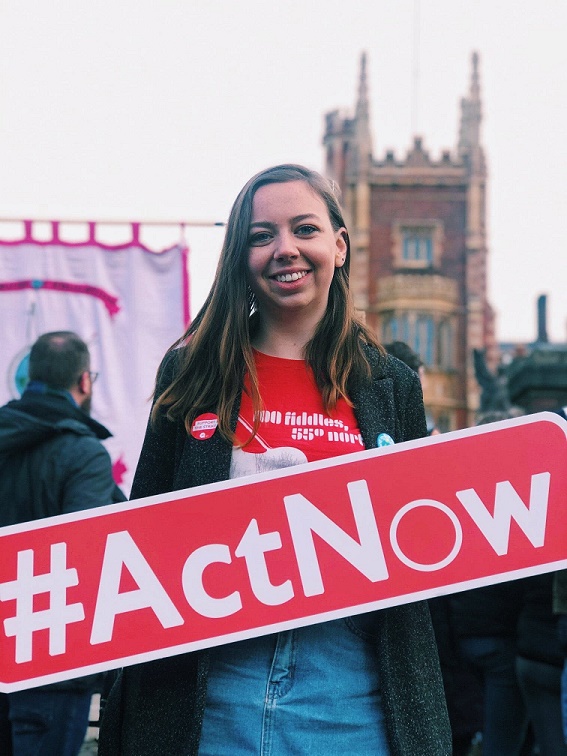
Q. So you’ve seen some positive changes even in that period of time [the four-and-a-half years Katie has been at Queen’s]?
A. Yeah. I definitely have. I mean, there’s definitely more tolerance I would say for the language in that time. I think it’s gradually shifting to a point beyond tolerance and acceptance and then beyond that will be, you know, into function and if we get an Irish language Act between now and then that will speed up the process significantly.
Q. What do you think is the future for the language then in Monaghan, in Belfast, how do you see things moving? Do you imagine a future where there are more Irish speakers or more room for Irish language culture?
A. I definitely do think there’s a space there. I think that is part of the future and I think that, you know, we’ll never be back to a stage where the whole of the island is speaking Irish, but I think that’s OK. I think that if everyone feels that they are part of that culture and they’re welcome in that culture and welcome to learn the language, I think that’s where we would like to be – that everyone has that opportunity, everyone can do what they need to do and if people want to live their lives through Irish< that there’s no barrier in doing so. There are many other places around the world – many other countries – that do have bilingual culture. They are generally just bilingual. Everything is available in two languages and that’s how it goes, and I see no reason why we shouldn’t be the same. The Northern Irish Government and the Irish Government all need to say ‘We all need to do a lot more here’. As many problems as there are in Northern Ireland there are still a lot of problems in the Republic of Ireland as well in the promotion and funding of the language. I think our Gaeltacht communities are such a core part of that. Obviously I didn’t grow up in a Gaeltacht but many of my friends grew up in Gaeltachts and those communities are being decimated by the complete lack of funding and the complete lack of care by the State and those communities are so core to what we do. We’ve no issue sending our teenagers over there every summer but are refusing to fund the families outside of that time. It is crazy that we’re in this position and if we don’t support those communities, support the areas where the work is happening, then what’s the point in doing any of the work at all? There’s still so much needs done. The education side is another one. It’s so difficult for the vast majority of people to come – like you said earlier [in reference to myself] – the vast majority of people in Ireland are coming out of 14 years at school and still wouldn’t be able to do much with the language after that time, and I think that’s a failure of our education system if that’s the position that people are left in. What’s the point of 14 years of language classes if people can’t speak it at the end? So, I think that needs definitely looked at, you know? It needs a total review of what that should be and how we teach – how we examine the language as well – all needs reviewed. Gaelscoileanna and Gaelcholáistí all need funding and there needs to be opportunities for more of those to open. The number of them has definitely increased over the years but more and more support needs to be given to those schools too. Not much to it! [Laughs]
I spent 4, 5 or 6 summers up in Gaoth Dobhair and I loved it there.
Q. Do you have a favourite Gaeltacht or a special place for speaking Irish, whether that’s your home or Belfast or somewhere else?
A. God. Em, I can’t say that I do have a favourite place but I do love the Gaeltacht. I haven’t been to a Gaeltacht in years – now, obviously Covid didn’t help that, and they’re just quite hard to get to –again the lack of public transport to them. But I spent 4, 5 or 6 summers up in Gaoth Dobhair and I loved it there. I absolutely loved every part of it. You’d just go anywhere and there was Irish everywhere but it was also so normal for me. For me and my family that was nothing. Like, it was just a continuation of our lives. But I look back and say ‘God, I really took all of that for granted!’ [laughs]
I also just love West Belfast. I see all the bilingual signs and I go ‘Oh God, yes. This is the thing that can happen across Belfast.’ So, I think there is lots of hope there, and there are lots of features that just need promoted and being pushed for more of the language and, yeah, we’ll see how we go! [laughs]
End/Críoch
Agallamh le Derek Hollingsworth, an 31 Eanáir 2022
Buíochas le Katie as agallamh a thabhairt dom!
Katie Ní Chléire: toghadh ina Uachtarán Aontas na Macléinn, Ollscoil na Banríona, Béal Feirste, í ar 5 Márta, 2021.
 Irish Language matters