
Mícheál Ó Foighil is the manager of one the best known Gaeltacht Summer Colleges, Coláiste Lurgan
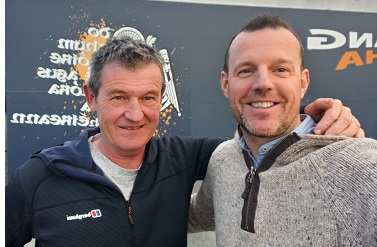
Mícheál Ó Foighil is a legendary figure in the Irish language community. He is recognised as much for his passion and outspokenness as he is for running Coláiste Lurgan – a Gaeltacht summer college or Irish language summer school – in the Indreabhán Gaeltacht in Conamara. He is energetic, witty and engaging in person, and is a passionate advocate for the cultural jewel that is the Irish language.
Mícheál Ó Foighil is not afraid of courting controversy. His views on education and the Irish language have been expressed publicly before.
When I asked Mícheál if his job title is Bainisteoir (Manager), he said he is the bus driver or whatever is required at the college on any given day. A former science and biology teacher, he’s a man whose energy and passion is infectious. His parents moved to the Gaeltacht when he was young. His own home was bilingual when he was growing up with both Irish and English, but it was his mother’s passion for the language – though she wasn’t a speaker herself – that stands out for him.
The vision
One of the most eye catching elements of the approach of Coláite Lurgan is the production of music videos that are then circulated on social media such as YouTube. Their version of Avicii’s ‘Wake Me Up’ has been viewed 8.4 million times at the time of writing.
Coláiste Lurgan
Despite the fame of Coláiste Lurgan, Mícheál is modest when it comes to their reputation and says there is no difference between themselves and any other coláiste samhraidh (Gaeltacht summer college). The demand for Gaeltacht courses has always been high and it may be increasing – while the number of places available are dropping – leading to disappointment for some. Media stories regarding a shortage of Mná Tí (Hosts for Gaeltacht students) isn’t such a problem there, according to Mícheál. There are 500-600 beds available for each course, though the Coláiste Lurgan campus has limits on the numbers they can take. The site is due to be developed in the coming years – work that is due to be completed by 2027. The plans show an incredible building with state of the art facilities for language classes and for sound and video recording. Galway County Council confirmed permission for the redevelopment of Coláiste Lurgan in July 2024 and there is huge excitement about this for the staff of the college.

The Declining Standard of Irish
Mícheál is outspoken when it comes to the declining standard of Irish of the pupils coming to the Gaeltacht over the decades. ‘Is there a trend? Definitely. Is it for the better? No way. It’s abysmal.’ He uses the same adjective when describing the Department of Education’s understanding of how to entice people to engage with, and interact with the language. ‘Things are deteriorating.’
He is a strong believer that people want Irish and value it – even if they don’t have it themselves. They want it for their children.
Míchéal contrasts Thomas Davis (Young Irelanders, Wests Awake, Nation Once Again) and the Catholic Emancipator, Daniel O’Connell.
MÓF (Mícheál Ó Foighil): ‘Daniel O’Connell (himself a native speaker) came to Galway in 1843 and he addressed a monster meeting of 80,000-90,000 people in Shantalla, then on the outskirts of Galway. The vast majority of attendees did not speak any English, but he addressed them in English. He wouldn’t speak to them as Gaeilge at all. He regarded the language as something that was to be cast aside as quickly as possible. That was holding the country back.’
For Davis, language was more important than political borders.
MÓF: ‘He (David) didn’t speak the language, but he recognised it for what it was.’ ‘Forget borders, terrirories. Language is a much more important frontier. He wasn’t a Gaeilgeoir. He recognised the crucial role language played in identity.’
Mícheál points to various characters from history who did not come from an Irish speaking background but who did a lot for the language: Thomas Davis (Welsh father), Pádraig Pearse (English father), Éamonn De Valera (American origins). I asked is there a post-colonial aspect at play in the language issue in Ireland ‘No. No. I’d say it’s just down to pure incompetence on the part of the education system.’
Mícheal is adamant that ordinary people want Gaeilge – even if they don’t have it themselves – they want their children to have it. He says ‘There’s a huge interest and empathy for the language but unfortunately this is not catered for by Marlborough Street.’
MÓF: ‘Language acquisition is simple and straightforward. A child doesn’t have to go to school – a child doesn’t have to be taught grammar to acquire a language. We’re all hard-wired to learn languages. Learning language is straightforward [for children]. All you need is exposure, commitment and enthusiasm along with a load of practice. You wouldn’t find it difficult to learn a language if you had to at any particular point. A few weeks of intensive practice would have you functionally fluent in any language. There’s no magic wand – it’s very, very simple. Practice and effort.
The biggest thing is spoken Gaeilge is not valued by the education system. You’ve people coming here (to Conamara) and they think that learning a series of words – especially makey up words – for various objects is what language learning entails. Also, that it’s confined to a classroom. That’s all they’ve ever experienced.’
ILM (Irish Language Matters): ‘So it’s living language that’s more emphasised here, would that be right?’
MÓF: ‘To acquire language all you need to do is give it space. Like, you have to put English to one side. That the one thing you need to do. Just stop speaking English. Students come through our school system, and 80%/90% of the time, the language is presented to them in English, reinforcing the lack of value on spoken Gaeilge. Young people doing the Leaving Cert. do not need to be able to speak Gaeilge – not in any kind of meaningful way, to succeed at the exam.
Gaelscoileanna
MÓF: Maybe that’s one of the unintended consequences of Gaelscoileanna. ‘You’re not the Gaelscoil – that means you’re not interested in Gaeilge.’ It’s just a free pass for all other schools and teachers to ignore the language. That’s a consequence of having a two-tier system. My experience of dealing with students…prior to Gaelscoileanna (I have been around for a long time), was that standards of spoken Gaeilge, in general, was much, much better. The standard of Gaeilge has deteriorated quite a lot, in my opinion.
“No-one has ever become a GAEILGEOIR inside a CLASSROOM.”
— Mícheál Ó Foighil
ILM: Would you like to see an expansion in the number of Gaelscoileanna? It’s only at 8%, I think, outside the Gaeltacht.
MÓF: The vast majority of students coming here, they wouldn’t be from Gaelscoileanna. Some of our best students hold their own when compared to those who have attended Gaelscoileanna. I don’t see any great dividend from Gaelscoileanna. However, I am not a fan of having a two-tiered system.
It’s said that every school should be a Gaelscoil. Yeah, that’d be great. That would be fantastic. But we need to address the very basics about acquiring Gaeilge regardless of being in a Gaelscoil or in a mainstream school.
The education system has the students’ undivided attention for 13 years. Lay out a graded 13 year programme. There has been a 20 year plan, do you know? That was supposed to have 250,000 daily Irish language speakers. These were ridiculous, nonsensical numbers. Instead of having this pie in the sky aspirations, let’s have something practical like a 10 year plan where you’re going to rectify how Gaeilge is addressed and presented in the education system.
A 10 year plan to completely reform a system that just turns people off, that’s completely ineffective. As you say, people getting As in their Leaving Cert. and they haven’t enough Gaeilge to put out the cat, like. In 10 years’ time you have a fully functional modern effective programme running over the 13 years [of State education] where people are improving, connecting, claiming ownership. Of course, this needs to be based on practical, and everyday Gaeilge. And taken outside of the classroom. No-one has ever become a Gaeilgeoir inside a classroom.
Even here in our Cúrsaí Gaeilge, this transition into becoming a Gaeilgeoir does not occur inside a classroom. This happens when they’re chatting to a Bean an Tí (literally ‘woman of the house’ or Gaeltacht host) or to a cinnire (a Gaeltacht guide or supervisor) or casually talking to someone else, but it’s always outside of a classroom. Even when inspectors come here, they don’t want to look at any aspect other than what happens inside the classroom.
ILM. But isn’t there a failure for society generally to create a space for Irish because kids aren’t stupid. They leave here or they leave the Gaelscoil – even within the gates of the Gaelscoil where the parents are speaking in English with the teachers…
MÓF: There’s nothing wrong with speaking English…
ILM: There’s no space for Irish, is there?
MÓF: The problem is the lack of value that’s on it (spoken Gaeilge). There’s no educational value placed on it. For the Leaving Cert., the most important thing is to get good grades. Sure it is but why not be clever about it? Give most value on being able to speak/converse… Continuous assessment is a must. It should begin in first year and it should accumulate right up to state exams. These are things that should come into play if you had an overall ten year plan – giving people what they want. People want to be able to speak Gaeilge.
ILM: All the opinion polls say that, don’t they?
MÓF: And they are true. I believe it. It’s high time to deliver on what most people want.

Gaeltacht Fees
ILM: In relation to all businesses, overheads have gone up in recent years: fuel, power, electricity, staffing, all the rest of it. And the experience you provide for money is definitely value for money. Is there anything more that can be done to open up the Gaelcholáistí to kids from disadvantaged backgrounds?
MÓF: Governments say that they’ll do this and that but they don’t. They’ve never approached us about this issue. All our bookings get done in a number of days like.
ILM: So they sell out in that time?
MÓF: Yeah, but this is another example of blather from Government ‘Oh, we’ll do this, we’ll provide places…’ but no-one from government has ever come to us and said ‘Listen, would you hold some specific places for us.’ We’ll do it – no problem.
But talking of the price, it has become very expensive. Historically, the Government support for parents was much greater. It would have been about 40% of the overall package I’d say, going back to the 70s, 80s. The State used to pay the teachers indirectly.
Now, they give a grant towards accommodation but the Department of Education used to cover the costs of teachers also. At the moment, I’d say Government support is about 18% of the total cost. That’s down from 40% in the 70s/80s. Lurgan’s fees are €1,130 at the moment. (There are 3 x 22 night courses and 1 x 15 nights offered at Coláiste Lurgan). As far as the price is concerned, I think it has become much too expensive. I would be strongly of the opinion that the cost to parents should not exceed €800 for a 22 night course with the state making up the difference.
ILM: That you’re aware of, what kind of help do people get, because I’ve seen scholarships from GAA clubs and Trade Unions and stuff like that. Is that kind of typical of the supports that people might get?
MÓF: There are VEC (Vocational Education Committee) ones and various organisations as well but they’re hoping there’ll be places available after Christmas or into Springtime but that may have been the case 30 years ago, but not today.
We used to take 2,000 students over four courses when we had been using the old Lurgan building. We have dropped numbers because we don’t have the amenities. We’re at four hundred now per course at present and will be until such time as the new development is completed. We fully expect to be able to increase the available accommodation in ‘tithe lóistín’ in that time.

Removing Resistance and Having Fun with Gaeilge
ILM: Do you have any way of measuring your success with the kids?
MÓF: No, not really. But one phenomenon you would definitely notice – and I’ve seen it year after year. It has to do with returning students.
You would notice a substantial improvement in their language skills from the previous year. You would know them from the previous year. Then you go ‘Wow!’ Where has this improvement come from? It’s all about exposure. People learn in so many different ways. It’s down to some connection with the spoken language being created. It means that whatever work they do in school, it goes in much deeper. It’s like their resistance towards the language is gone. When they come back in a subsequent course, the resistance is gone. What value would you put on that? I’d put the highest value of all on it. That they feel comfortable and confident, and they enjoy and recognise the language for what it is – just something to have some fun with and enjoy using.
State of the Gaeltacht: ‘There’s no-one throwing in any towel’
– Mícheál Ó FOIGHIL
State of the Gaeltacht
ILM: I’m just wondering what state is the Gaeltacht in, what changes have you seen over the last 30 years and is there any cause for optimism or hope at this point?
MÓF: There’s always cause for hope. There’s no-one throwing in any towel. Even though the numbers are stark and are trending in the wrong direction especially amongst the youth. There is challenge with identity awareness as there is amongst young people nationwide. I make out that this stems directly from the sorry state of the language in the education sector. Young people see for themselves how poorly Gaeilge is being taught around the Country. People in Gaeltacht areas are not shielded from this negativity. We in the Gaelacht also struggle, same as rest of the country, with a sense of ownership and responsibility towards the language. We don’t live in a bubble. The biggest influence on Gaeltacht areas, in my opinion, is the apathy towards the spoken language in the rest of the country.
ILM: Do you think that’s State apathy or social apathy?
MÓF: No, not intentionally, but that’s the direct result of undervaluing the spoken language throughout the education system. This is where education needs to really step up to the mark. To develop a sense of ownership and responsibility towards our language. Who owns the language and who’s responsible for it?
Almost a century ago Myles na gCopaleen made a telling observation in his brilliant satirical book, “An Béal Bocht”. The then establishment placed the full burden on Gaeltacht areas to preserve the language while the rest of the country did absolutely nothing, other than to lecture Gaeltacht areas on their “responsibilities”.
In my opinion the most significant influence on the Gaeltacht is the really abysmal way that Gaeilge is taught in mainstream schools. Gaelscoileanna (while being very positive) are not the solution for this. The solution is in having an effective, meaningful, relevant 13 year language acquisition program in all schools. Gaelscoileanna as well as mainstream schools.
ILM: My attitude to that would be ‘All I can control is me, so I have to do something about it.’ But I don’t think everyone thinks like that.
MÓF: Most people have not attended Gaelscoileanna. Most people have never been given the opportunity of attaining the language while in school. The clear message being that ‘Gaeilge is too difficult’ or too irrelevant. The exact same message being relayed by Daniel O’Connell almost 200 years ago. This is completely untrue as Gaeilge is one of the easiest languages to acquire.
ILM: Why do you say that?
MÓF: Ask any polyglot. The structure of the language is very easy to follow. There are some differences to English alright. If you were to bring someone from a foreign country and they could speak neither Gaeilge nor English and you gave them the same learning materials – Gaeilge would be the easier to learn. You’ve only 11 irregular verbs in Gaeilge, you’ve hundreds in English. It’s not a difficult language. Gaeilge being difficult to learn is a myth. It’s just an excuse to do nothing.
It is also a ready-made false excuse for teachers who have no interest in teaching the language.
If you went to a doctor, and then the doctor told you ‘Listen, ah sorry I don’t do anything with hearts. I’m good with ears and eyes but I don’t know anything about your heart. You’d say, ‘God, that’s not a doctor’. Apply the same criteria to a teachers work. Gaeilge is a core subject. Teachers are language professionals. They’re being generously paid by the State to teach Gaeilge amongst other subjects. There are 20,000+ teachers in primary education. A legitimate question is to ask why the return on the vast amounts of state funding is so poor. There’s something radical that needs to change about how Gaeilge is taught in primary school. Maybe Gaeilge need not be the forte of all teachers and teachers could rotate according to subject strengths.
It galls me to see so many wasted opportunities to get students connected to their own language and the astronomical cost incurred by the state only to reach such a negative outcome.

Gaelic Identity
ILM: There was research in Sabhal Mὸr Ostaig (Third Level College operating through Scots Gaelic on the Isle of Skye) where Conchúr Ó Giollagáin and Tim Currie Armstrong work, and I think they found that children and teens that identified as a Gael were much more likely to identify with Scots Gaelic. Do you think that kind of identity is lacking in Ireland?
MÓF: People will say ‘Oh. Just because I don’t speak Irish, does that make me not Irish?’ Of course it doesn’t. But in my opinion not having Gaeilge puts you linguistically into the Anglo (Na Gaill) category as opposed to being a Gael (Na Gaeil). That is to say there are two linguistic traditions – Na Gaeil agus na Gaill. Ideally Irish people would be bilingual. What’s a Gael you might ask?
ILM: A Gael is an Irish speaker.
MÓF: A Gael indeed is an Irish speaker. We are completely free to speak whatever language we wish.
It’s my opinion that a sizable minority would like to use much more Gaeilge in their daily lives and regret not having better acquired the language during their 13 years in state education. The fact remains that the 13 years spent in school will always be the most influential and best opportunity to acquire the language.
At present we have many language organizations (ourselves included) trying to rectify the real shortcomings of the education system regarding acquiring the language. But, that is all we are doing, trying to rectify the damage that has been inflicted. It would be a much better situation if these organizations were supplementing a well-run system.
The Education System
Mícheál points out that all the organisations working for the Irish language cannot compete with the scale of the education system. He suggests that the education budget for Irish is largely being spent while giving a message that Gaeilge is actually impossible and that you don’t need it.
MÓF: You have all these excellent voluntary or State-supported organisations: TG4, the Raidió (Raidió na Gaeltachta), you have Conradh (Conradh na Gaeilge), you have the Coláistí Gaeilge. You have all these, but we are all merely a pittance in comparison to the 1 billion + annual budget that the Department of Education spends directly on their own Irish language programs. Just imagine how much better state the language could be in by getting that huge funding working for the betterment of the language?
We have our political leaders and they would be sympathetic and empathetic towards the language but none of them are willing take any political responsibility for the failure in Irish language education in the state program. There is absolutely no political accountability. Unfortunately, Gaeilge would not feature in the top 50 priorities of either of the country’s political leaders.
The underlying problem will Gaeilge lies in Marlborough Street, the Department of Education. There is no leading politician going to challenge the Inspectorate in the Department of Education or going to ask them to do anything differently. Unfortunately they will roll over and do exactly the biding of the inspectors in Marlborough Street.
How I would love to be proven wrong.
Deireadh – End
If you wish to give something small towards the cost of running the site, my Revolut is @derekis3j
What do you think? Inspiring? Why not leave a comment below?

Foghlaim Gaeilge – Learn Irish
Follow Me
Get new content delivered directly to your inbox.
 Irish Language matters
2. Ba bhreá liom fógraí ag rá , Tá Béarla againn, màs gà. Gaeilge mar ‘default’ mar a déarfá. Agus cinnte, plean againn le húsáid na Gaeilge a mhéadú chuile bhlian I bhfeidhm. 3. Is Gaeltacht í an tír ar fad más mian linn é.
LikeLiked by 1 person
GRMA as do thuairmí! Is bóthar fada é cinnte, ach tá daoine ag obair go dian ar son na cúise. Ceapaim go bhfuil rudaí ag feabhsú i nginearálta – ach go mall!
LikeLiked by 1 person
bhí múinteoir Iontach Gaeilge agam sa mhéanscoil.. & las sí solas ionam don teanga. Tá mé i mo chonaí san Astráil le fada ach is Éireannach mé sa deireadh & tír gan teanga tír gan dóchas..
LikeLiked by 1 person
Maith thú a chara. Tá do chuid Gaeilge agat fós ar aon nós. Bíonn sé go deas i gcónaí scéal cosúil le sin a fheicáil.
LikeLike