November 2022
Just like Irish, the Welsh language is not simply a minority language, it is a language that was intentionally minoritised in its own homeland. Believe it or not, the Welsh language has only had official status since 2011, with the passing of the Welsh Language (Wales) Measure 2011. This Measure granted the Welsh language, or Cymraeg, Official Status for first time since 1536. A lot of work has been done to protect the language and, though more challenges lie ahead, there is a now a sense of confidence that the Welsh language is turning a corner, and that it can grow in the future.
History
Between 1535 & 1536, the Tudor Monarchs enacted laws to establish the supremacy of the English language, disadvantaging Welsh speakers in Wales. This triggered a host of social and linguistic changes. The entire ruling class would be anglicised and a language shift occurred with Welsh declining and English becoming the language of power.
The erosion of Welsh continued over centuries, Welsh being excluded from the domains of administration and law. The nineteenth century saw stigmatisation of the native language with the use of the infamous Welsh Not in the education system – used to single out children who had spoken Welsh. This had a counterpart in the bata scóir in Ireland.
By the twentieth century Welsh had become a minority language and English had become dominant in Wales for the first time in history. The number of Welsh speakers eventually bottomed out at about 20%, meaning that Welsh is more widely used than the Gaelic languages; Irish, Scots Gaelic and the Manx language of the Isle of Man.
Why Welsh Remained More Widely Used
There are a number of reasons why Welsh retained a larger critical mass than Irish. This has been attributed to the Church retaining use of Welsh versus the Anglicisation of the Church in Ireland; a more concentrated geographic heartland of speakers – Y Fro Gymraeg is the Welsh speaking region and equivalent of the Irish Gaeltacht; and the fact that Wales didn’t have anything like the Highland Clearances of Gaelic Scotland, or An Gorta Mór/The Great Hunger in Ireland.
Awakenings of a Broader Welsh Language Movement
The first Welsh language primary school opened in Aberystwyth in 1939. Plaid Cymru, the Welsh Nationalist Party, was also formed in the Twentieth Century, pledging to promote the Welsh language. But the genesis of the movement that is now in its stride was as late as the 1950s and 1960s. I spoke with Carol Jenkins, General Secretary of Cymdeithas yr Iaith (the Welsh Language Society) who told me:
‘It was probably towards the end of the 50s and beginning of the 60s that the people of Wales started to wake up – especially so after the broadcast of Saunders Lewis’ Tynged yr Iaith (The Fate of the Language) [a radio lecture] in 1962 which led to the setting up of Cymdeithas yr Iaith a few months later and the first mass protest on Trefechan Bridge a year later.’
The broadcast of Tynged yr Iaith, which predicted the extinction of Welsh without urgent action caused a stir, and has been cited as the catalyst in the creation of the Welsh Language Society and the commencement of non-violent direct action campaigns. This has been one of the strategies of the Society – direct action agitating for increasing the status of the language. People are encouraged to take responsibility for the advancement of the language including actions such as engaging in correspondence, protesting or painting slogans in public places. The public pressure started to have some successes. The introduction of the Welsh Language Act in 1993 required public bodies to recognise the Welsh language and the English language as equals.
Carol Jenkins again, ‘The setting up of the first Welsh television channel S4C in 1982 and the National Assembly (now the Senedd) in 1999 have also helped, and of course more Welsh language primary and secondary schools, and the setting up of the Coleg Cymraeg Cenedlaethol (national Welsh college) in 2011′.
Struggles of Language Movements
It is important to recognise that some of the obstacles put in the way of progress for the Irish language are not untypical, particularly in places where colonisation has occurred, including Wales. There are often arguments put up against Welsh, such as expense and utility, and in Wales, like in Ireland, native speakers are often asked to justify the language in the face of ignorance or hostility.
Benefits of the Welsh Language Measure of 2011
The Measure saw the establishment of a Welsh Language Commissioner with responsibility for legislation, regulation and promoting the language. The Welsh Language Measure tries to assure that Welsh people have the ‘Freedom to use Welsh’ with others without fear, and that companies – not limited to the public sector – can be investigated for interfering with this right.
In 2018, the then Welsh Language Commissioner Meri Huws said that the Welsh Language Measure had increased the audibility and visibility of the Welsh language, creating many more opportunities to speak the language. This, she said, was helping to create a confidence that Wales is becoming a bilingual country. She said that the broader range of public service provision in Welsh had prompted many businesses not governed by the Measure to reciprocate, and introduce services in Welsh leading to further opportunities for use. In the same interview, Ciarán Mac Giolla Bhéin of Conradh na Gaeilge said, ‘The Welsh model has demonstrated that positive legislation has created attitudinal changes in terms of how the Welsh language is viewed…’
More recently, in 2022, Welsh First Minister Mark Drakeford recommended ‘immersion’ education – education through the medium of a language – for the successful teaching of Irish, on the basis of the results they have seen in Wales: ‘the immersion methods have succeeded in turning generations now of young people into genuinely bilingual citizens.‘

The Future of Welsh-Medium Education
Welsh is taught to all children in Wales but there are predictably mixed results for those taught Welsh as a subject, rather than through the medium of Welsh. Welsh-medium education seems to be yielding far greater results. The Welsh Government’s current target is to increase the proportion of each school year group receiving Welsh-medium education to 30 percent by 2031, and then 40 percent by 2050. Some Welsh language campaigners are seeking for all education in Wales to be through the medium of Welsh by 2050. Carol Jenkins told me:
We are currently holding a consultation on our own Welsh Language Education Act where we lay out the cause for every school child in Wales to receive a Welsh-medium education. This means that every school would be placed on a path that would lead to Welsh language education for all by 2050. We also believe that there should be one qualification in the Welsh language and not Welsh First Language and Welsh Second Language as is the case at present. The main aim for this is that Welsh would be the natural language of every school and not an academic subject which leads to people not being able to converse in Welsh or have any interest in pursuing Welsh language activities outside the school.
While accepting that the native language base in Wales in much broader, with figures like this being spoken of it prompts the question if we are ambitious enough for the scope of Irish-medium education. In 2021, 24% of children in Wales attending primary school were taught through the medium of Welsh. Statistics from a couple of years ago had 8.6% in Irish-medium education in Ireland and 4.4% in the North of Ireland.
Conclusion
Protection and promotion of the language, respect for the language, and the expansion of Welsh-medium education would appear to be priorities in Wales. The Welsh language is currently in a stronger position than Irish, with the histories of both languages overlapping in certain ways. It may well be instructive for us in Ireland to pay attention to what appears to be working in a practical sense in supporting the native language in Wales. In language matters, the wheels of change can turn slowly – as they did in the planned anglicisation of Britain and Ireland. What is required to counteract this is ordinary people taking responsibility for their languages, radical action to address the situation and an intergenerational movement to ensure the preservation and growth of our native languages.
November 2022
With thanks to Carol Jenkins, Ysgrifennydd Cyffredinol (General Secretary), Cymdeithas yr Iaith (The Welsh Language Society). Diolch! Gabhaim buíochas lei!
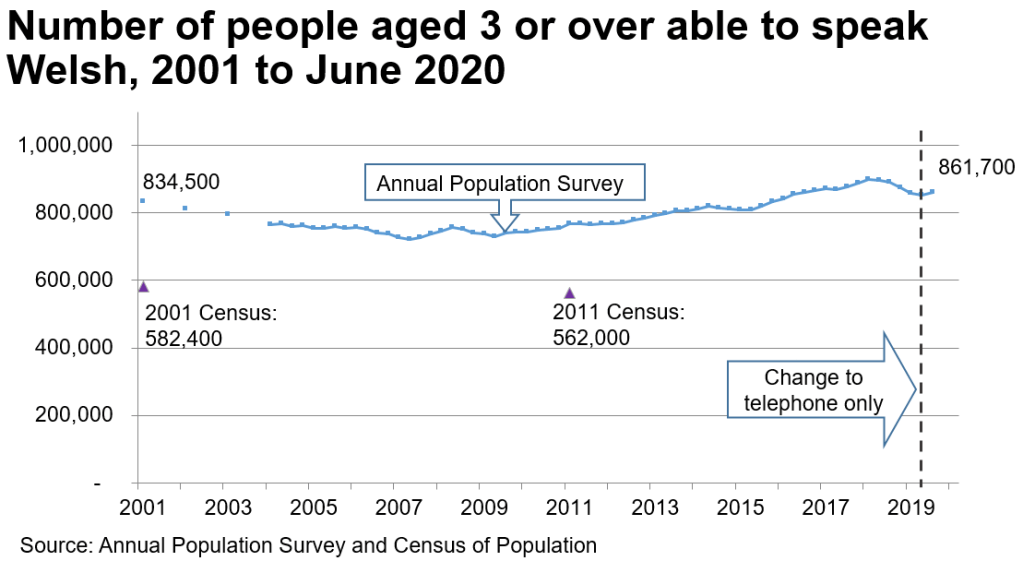
For the year ending 30 June 2020, the Annual Population Survey reported that 28.5% of people aged three and over were able to speak Welsh. This figure equates to 861,700 people.
–Welsh language data from the Annual Population Survey: July 2019 to June 2020
The latest figures on the 2021 Census with regards to the Welsh language will be published on 6 December: https://www.ons.gov.uk/releases/welshlanguagecensus2021inwales
Heledd Gwyndaf, Cadeirydd Cymdeithas yr Iaith | BBC Breakfast
Note re Language Acts in Ireland
After many years of campaigning by language groups in the North of Ireland, including An Dream Dearg, the Identity and Language (Northern Ireland) Bill passed its third and final reading in the House of Commons in October 2022.
The Official Languages Acts cover the rest of Ireland.
If you wish to give something small towards the cost of running the site, my Revolut is @derekis3j
Follow Me
Get new content delivered directly to your inbox.
 Irish Language matters