
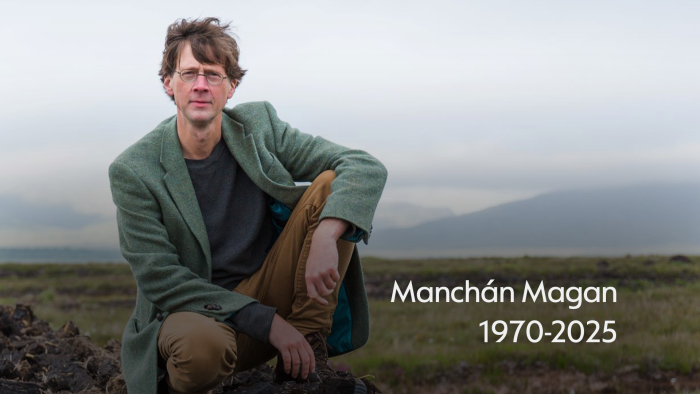
It’s the Irish words that seem most appropriate in describing Manchán: seanchaí, saoi, scríbhneoir, saineolaí, ollamh, oide, file, fear fasa. He was all of this and more.
Our Cultural Icon
I happened to have an online Irish class on the morning the news came that Manchán Magan had passed to the other side. I exchanged shocked text messages with a friend who had written a wonderful picture book inspired by Manchán. Fittingly, Manchán was all over social media that day. There were thousands of posts: messages of love, grief at his passing, photos, clips from his shows, news articles and obituaries. There was an outpouring of sorrow. There were tributes from thousands of ordinary people – many of whom who aren’t in the habit of posting on social media, who felt compelled to share their sense of loss.
Two friends that I know of – an Irish speaker and a learner – were texting me saying they were crying. I was crying. We all felt like we had lost our torch-bearer. He had been everywhere: his magical books, his thought-provoking documentaries and series on TG4 and RTÉ, his enlightening podcasts, his wonderful YouTube videos, his plays, and his presence in recent years on social media. He was our omnipresent guide. It felt like he would always be there to lead us learners. It felt like there would be many shared times ahead. Is mór an chaill é Manchán.

No Béarla
I first discovered Manchán Magan around 2011. I think TG4 were rerunning the series No Béarla. I must have recorded the series because I watched it late at night, as I was feeding my then baby. Manchán was our company at feeding time. The idea of the show was that it would be impossible for anyone to live their lives exclusively through Irish outside the Gaeltacht. Manchán travelled around Ireland speaking only Irish to strangers. He was occasionally laughed at or mocked. There were some hilarious set-pieces with Manchán a lorg coiscíní (condoms), and performing a filthy song while busking in Galway. Due to some of the hostility encountered, No Béarla demonstrated that you’d have to be a bit brave to go around speaking Irish in every context in Dublin. But Manchán was fearless without being confrontational. The show made an impression on me. If things were that bad, maybe I needed to get on board and learn to speak the language.

Meeting Manchán
In November 2014, I spent an early evening speaking with Manchán about the Irish language in a hotel bar in Ballsbridge. He agreed to meet me to discuss the language even though we had never met before and I was a total nonentity in any relevant way. I did not speak Irish, I was not an academic in a related field, and I had no social media accounts – nothing. Manchán still gave me three hours of his time. I have 90 minutes of that conversation recorded on a Dictaphone and, like my grandfather’s memoirs; it is one of the most precious things that I possess. Spreag Manchán mé. Manchán inspired me then, afterwards, and he will continue to do so.
Radiant Spirit
Bhí anam lonrach ag Manchán. He was a gentle, kind and beautiful soul. He has been described as “the most non toxic man”. You could easily mistake his gentleness for naivety, but in reality he was just about as worldly as anyone could be! His wild adventures on his travels are like some far-fetched novel. He seems to have been driven by curiosity, an open mind and a free spirit. He lived his life on his own terms, on his own land, in his own self-made house; yet he retained that trademark politeness, kindness and a total lack of cynicism.
A Great Legacy
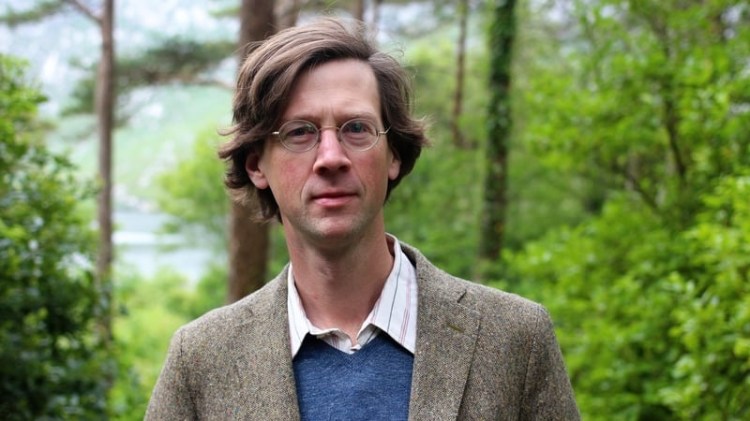
Manchán leaves us a great legacy. For those of us that felt like we knew and loved him, it’s gutting. It is difficult not to contemplate what else he would have achieved if he had lived to his 80s, surrounded by his maturing oaks.
He was prolific, and his love for his subjects and his storytelling talents made his enthusiasm infectious. Of all the reasons for his greatness, one stands out for me. I think his genius was that he showed the world the Irish language as a distinct beautiful treasure, not necessarily connected to nationalism or Catholicism, two concepts that many people had rejected the language for, by perceived association.
Buíochas le Manchán
When Manchán gave me that interview back in 2014, I thanked him by giving him an oak sapling in a pot. As I watched Manchán head off into the November Dublin night, my oak sapling in the basket of his rented Dublin bike, he really looked every bit the eccentric free spirit. Attendees at Manchán’s funeral were offered apples and acorns from his land – his little paradise. And there we have it, literally in a nutshell: Manchán has given us the means to grow great woods.
As Manchán’s brother, Ruán, put it, “He has shown us the path. It’s up to us to walk on it.”
Buíochas leatsa, a Mhancháin, le meas agus grá i gcónaí.
an 10 Deireadh Fómhair, 2025
Did Manchán inspire you?
Leave a comment below /Fág cúpla focal thíos.

 Irish Language matters
Leave a comment here!