One of the reasons we need the Irish language now more than ever, is that it provides a social and intellectual space for discourse, free from the propaganda and neo-colonialism of the toxic Anglosphere. Tír gan teanga, tír gan anam, tír gan saoirse, tír gan neamhspleáchas.
Controlling the Narrative
The world is changing. Decades old certainties and assurances have been swept away as geopolitical instability becomes the norm. We have witnessed “the first genocide in history where its victims are broadcasting their own destruction in real time” in Gaza. There is uncertainty about global peace and stability with war and international insecurity a growing theme. Culturally, Language wars have long been fought, and they will continue to be. The United States has designated an official language for the first time in its history, English. The English-Only campaign has long been linked with disadvantaging Spanish speakers, of which there are tens of millions in the US, as well as discrimination against minorities. It’s also about controlling the narrative. English speakers good, non-English speakers bad. We in Ireland should be cognisant both of the darkening clouds over the Anglosphere, and the fact that our narrative is controlled externally.
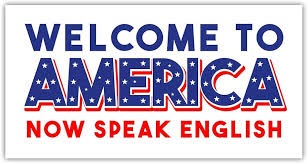
The Anglosphere Does Not Respect Other Languages
There is a reason why British Prime Ministers have campaigned for English to be the language of education in countries around the globe – inevitably at the expense of education in the native languages. It normalises English as the default mode of human communication, creates an affinity with the Anglosphere and softens up consumer markets.
The Anglosphere has been remarkably effective at destroying the communities of other languages – especially the native languages in the countries where English is now the main language. In Ireland and Britain, English has managed (within mainstream discourse) to almost totally displace Irish, Scottish Gaelic, Welsh, Manx and Cornish – all of which were majority languages in their respective territories. Minoritised language speakers everywhere will relate to each respective group being told that any investment in their languages is a waste of money. This is a standard trope. Nobody – not even the native language organisations – ever question the amount of money spent on maintaining the status quo, spreading the dominant language into areas where the minoritised language is spoken, or promoting the dominant language more generally. It’s just not mentioned in English.

Reasons for Speaking Irish
All the reasons for speaking Irish that have always existed are still there. There is arguably the most obvious use of a language socially, which is in communication with other speakers. It can be a lot of fun to speak Irish socially, and it is good for our confidence as individuals and collectively. There are hundreds of thousands of speakers of varying abilities in the 26 counties alone. Technology allows for opportunities to use Irish online that never existed before. There are the songs, stories, literature and music that have for centuries made up so much of Gaelic culture. There remains the fact that speaking Irish ensures we are not kept in total ignorance when confronted with native Irish names, or family names. There is understanding the meaning and history of Irish placenames. There is the connection with our own history – a history we are cut-off from without Irish. From the perspective of a learner, there are all the cognitive and other brain benefits derived from learning extra languages that always existed. There is also what Chomsky said was the primary purpose of language – thought. And for anyone that speaks both Irish and English, they may well recognise a different worldview, or that they themselves feel different when speaking each language.

In English, We Are Defined Externally
When we speak only English, we permit our worldview and our self-concept to be defined almost wholly externally. That worldview often contains negative stereotypes about Irishness – the stage Irishman for example. Consider just some of the negative tropes with the name Paddy: paddy wagons, paddywhackery and the BBC’s Chief Football Writer’s reference to Cristiano Ronaldo “throwing a bit of a Paddy”. The latest is online Zionists calling Irish people ‘Paddystinians’ (an attempted slur referencing Irish revulsion at the mass slaughter of civilians in Palestine). We will never have full control over representations of ourselves in English. We will never determine the narrative about our own history (where Irish writers have adopted the English use of the term ‘rebel’ for every historical Irish figure who ever defended their clan, their community or their territory from invasion or encroachment – flip the circumstances and the nationalities and imagine English people being called rebels). We will never stop Western narratives elevating racists, colonialists, mass-murderers and war criminals to heroic status.
One More Reason to Speak Irish
In Irish, we dictate the narrative for ourselves, whereas in English we don’t. In Irish, we are a majority, whereas in English, we are a tiny minority. The Irish language provides an intellectual space where we can decide how we represent ourselves in all of our diversity and differences without outside biases – in our own words and concepts. Gaeilge provides us with a space for a national discourse on our own terms. The Irish language represents a platform for Irish people and those with ties to Ireland to engage in mature conversation about ourselves without the undue influence and the machinations of the Anglosphere. It is time to embrace our language for its full potential.
____________________________________________________________
The title of this piece is obviously a reference to the historic speech by Douglas Hyde. Hyde was a statesman. I was motivated to write this piece having witnessed two individuals who will never be statesmen haranguing a President of a sovereign nation in front of the US media. The Anglosphere is turning uglier, and we don’t have to follow it.
Foilsithe 1 Márta 2025
Follow Me
Get new content delivered directly to your inbox.
 Irish Language matters