Maolra Seoighe was an innocent man hanged in Galway Jail for a crime he did not commit. He was an Irish-speaker tried and convicted through a language he did not understand. On 4 April 2018 he received a posthumous pardon.

Background
The events that unfolded during 1882 took place in the wake of the Phoenix Park murders, and this may have had some influence on the wayward path to injustice that was to follow. On the 5th May, 1882, John Poyntz Spencer, 5th Earl Spencer arrived in Ireland as Queen Victoria’s representative in Ireland, the Lord Lieutenant. He would have a significant role in later events. In his company was Lord Frederick Charles Cavendish, who was to be appointed Chief Secretary for Ireland the following day. On the afternoon of that very day, 6th May, both Cavendish and Thomas Henry-Burke, the Permanent Under-Secretary, were murdered in grisly fashion in the Phoenix Park. The attack was carried out by a group calling themselves the Irish National Invincibles (often referred to as The Invincibles).
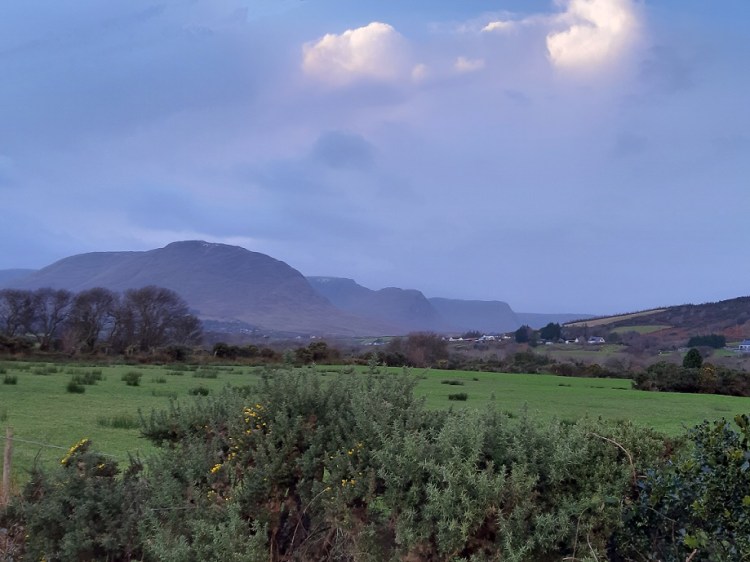
On the night of 17th August 1882 a horrific massacre took place in Mám Trasna, a remote rural location of dramatic natural beauty in Dúiche Sheoighe (Joyce Country), on the Mayo/Galway border. During the mass-murder, five members of the Seoighe family were slaughtered in the dead of night in their humble cottage. The brutal attack had been planned by a relatively powerful local man, Seán Mór Ó Cathasaigh (Big John Casey). On the basis of statements made by three men who claimed to be eyewitnesses, all aligned with Ó Cathasaigh, ten men were arrested in the aftermath. One of these was Maolra Seoighe, a married man with several children whose wife was pregnant. It is said that he was a quiet and agreeable man. Two of his brothers and a nephew of his were amongst those arrested on suspicion of murder – all four were totally innocent. The magistrate decided to try the men based on the three eyewitness accounts. The ten accused spoke Irish and had little or no English, with two notable exceptions.

Before the trials
Two of the men, the ones who could speak English, were to turn State’s Witness. One of these, Antoine Mac Philibín, had proof of his innocence. He had an alibi, having been at a wake with numerous witnesses including two men with whom he had walked home on the night of the attack. He approached the State’s Solicitor, George Bolton. Bolton spoke to the prisoner in Kilmainham Gaol without the presence of their legal representatives. The prisoner was given an offer. He could turn State’s Witness and corroborate the false account given by the three eye-witnesses, incriminating the other innocent men, or he could maintain his innocence and face trial, with the possibility of meeting the hangman in the end. Mac Philibín chose the former.
Then Tomás Ó Cathasaigh, one of the prisoners who was actually part of the murder gang, approached Bolton two days before commencement of the trial. He tried telling Bolton the truth of what had really happened, but Bolton wasn’t interested in anything that contradicted the eye witnesses. Eventually, Ó Cathasaigh agreed to become the second State’s Witness, corroborating the evidence of the three original eyewitnesses who had given false accounts of the murders.
As Seán Ó Cuirreáin has pointed out in the TG4 docudrama Murdair Mhám Trasna, it is interesting that the two best English speakers of the group of accused – both had worked in England – were recruited as informers. The Defence heard that the two prisoners were to be State’s Witnesses not long before the commencement of the trial. Their corroboration of the story told by the eye witnesses copper-fastened the Crown’s case, and hardened public opinion

English, the language of the Courts
The trials would take place exclusively through the medium of English despite the fact that several of the men understood no English at all. In 1737 the Parliament of Ireland passed the Administration of Justice (Language) Act (Ireland) which declared English to be the only official language of the courts – in a country where Irish was the language of the majority.
The fact that the trials would proceed through English would obviously cause great difficulties for most of the accused. There was no interpreter. Some interpreting was done for the Court’s benefit, by a police constable. This was only from Irish to English – no interpreting was carried out from English to Irish. What the judge and the prosecution said was not translated for the prisoners, so they could not understand what was being said about them. Under the circumstances, a fair trial was impossible.
Crucial evidence suppressed
The Crown’s team were aware of a crucial fact that was not shared with the Defence. The two boys that had survived the attack – one of whom had sadly died of his injuries the day after – had revealed that the faces of the men who carried out the attack had been blackened, and were unrecognisable in the dark. The jury therefore never came to question how the three supposed eye-witnesses could have recognised the attackers on the night of the crime. The unfortunate surviving child from the massacre, who had seen three men enter the house on the night, was not permitted to give evidence. His testimony was not permitted because it was established that he did not know his Catechism, nor was he aware what would happen to him if he told a lie. This disqualified him from being a reliable witness at the time. And so, the last opportunity to reveal the evidence of the blackened faces was lost.
The juries
The jury was made up of well-to-do people from Dublin without any understanding of the Irish language. They also may have subscribed to prevailing Victorian attitudes towards people from the Gaelic west of Ireland which were often ignorant, condescending and ingrained in Victorian society. For example, there were references made to ‘These wretched creatures from the west of Ireland’. The jury deliberated for 8 minutes for the first case. The second case took 12. Both juries returned a guilty verdict. On failing to understand the judge properly, one convicted man asked aloud in Irish on what day he was to be hanged.
Maolra’s trial
The third trial was that of Maolra Seoighe. The accused’s solicitor was inexperienced 24-year old Henry Concannon, who spoke no Irish. The jury for this trial had been present in the courtroom for the conclusion of the previous case, and had heard the judge praising the strength of the evidence. According to Margaret Kelleher, in a scene that could come from a tragicomedy, Maolra Seoighe confirmed that he understood information given to him by an interpreter in the Irish language. However, the court took it that he had confirmed that he understood evidence given in English, and the interpreter was dispensed with. Maolra Seoighe was also found guilty of murder and sentenced to death by hanging.
After Maolra Seoighe’s Trial
There were five remaining men to be tried. The Crown offered life sentences to these prisoners on the condition that they change their pleas to guilty. One of the five men confessed to the solicitor Concannon that all of the other four, and Maolra Seoighe were innocent. Concannon immediately brought this information to Bolton at Dublin Castle, who told him he wasn’t interested in a deal unless all five of the men pleaded guilty to the murders. Concannon relayed this to the prisoners and they refused the offer – four of them being totally innocent. Concannon then asked the men’s local priest to intervene. The argument put forward was that the men should avoid the hangman’s noose at all costs, and hope their innocence could be established thereafter. Subsequently, all pleaded guilty and were convicted. The only sentence available at the time was death, and so the final decision on the appeals of all eight men passed to the Lord Lieutenant, the so-called Red Earl, John Spencer. It has been suggested that Queen Victoria was strongly in favour of the hanging of all the prisoners. Spencer decided that the first three men would be hanged and the other five had their sentences commuted to life in prison.
The three men sentenced to death were transported to Galway Jail. Here, the two convicts who were to hang with Maolra Seoighe confessed that they had been part of the murder gang, but that Maolra Seoighe and four of the other prisoners were totally innocent. This information was taken to the Lord Lieutenant who telegrammed the prison Governor late on the evening before the executions, ‘The law must take its course’. Maolra Seoighe’s wife had made protestations of his innocence herself, begging the Lord Lieutenant for mercy, but to no avail. She would be left the widow of an innocent man, Maolra’s death leaving her to raise their five children alone.
Executions
The three prisoners were hanged on 15 December 1882. Maolra Seoighe had protested his innocence in his own language right until the last moment, even as the white hood was placed over his eyes, and before he dropped from the execution scaffold. In his distressed state he may have moved, inadvertently causing the executioner’s rope to tangle in his arm and preventing a quick death. It was an achingly sad and brutal end to the life of a quiet family man, known to be innocent of this crime.
Aftermath
Two years after the hangings, one of the informers who had testified against Maolra Seoighe, Tomás Ó Cathasaigh, approached the Bishop of Tuam during Confirmation mass at the church in Tuar Mhic Éadaigh. He confessed that his evidence had been fabricated and that Maolra Seoighe was innocent.
In the same year, Tim Harrington, MP for Westmeath, published a pamphlet attempting to discredit the trials, and suggesting that Bolton had covered up evidence that would have acquitted the innocent men. There were also allegations that there had been sectarian issues in the selection of the jury. Harrington made huge efforts to keep the issue live at Westminster and, unsuccessfully, sought a public inquiry. The new Lord Lieutenant, the Earl of Carnarvon, Henry Herbert, refused various appeals for an inquiry. In the end, two of the five who were imprisoned died in jail and the other three spent 20 years behind bars – these were the innocent two brothers and nephew of Maolra Seoighe.
In more recent times at the British Houses of Parliament, David Alton, Lord Alton, and the late Eric Lubbock, Lord Avebury, campaigned to have Seoighe pardoned. Again, these efforts failed to yield an official acknowledgement for the wrongs visited on the innocent convicted members of the Seoighe family. Journalist, and former Coimisinéir Teanga (Language Commissioner), Seán Ó Cuirreáin uncovered payments made by the Earl Spenser to the three men who claimed to be eyewitnesses – a total equivalent to more than €150,000 in 2016 money.
It goes without saying that Seoighe and the other innocent men were framed and let down by members of their own community – neighbours and relatives of theirs. Several people aligned with the ringleader, Seán Mór Ó Cathasaigh, were complicit in this. At the same time, the manner in which the trial was conducted and the concealment of evidence clearly demonstrate the injustice visited upon innocent people by the authorities.
In April 2018, on the basis of a legal examination it commissioned, the Irish Government advised Uachtarán na hÉireann (President of Ireland), Michael D. Higgins, to grant a posthumous pardon to Maolra Seoighe. This saw the Irish State issuing a pardon which predated the existence of the Irish State. Maolra Seoighe was pardoned on 4 April, 2018.
Insights into the on-going language shift at the time
The trials took place at a time when the Irish people were still considered uncivilised and subhuman by some within the British establishment. A monoglot Irish speaker would have been looked down on by nature of their ethnic and linguistic profile.
‘Most vulnerable in this bilingual world was the Irish monoglot, a category that the sceptical state often refused to believe even existed: denying any knowledge of English was seen by many officials as a strategy to subvert the judicial process’.[1]
Maolra Seoighe was a monolingual Irish-speaker living in a bilingual country that had lurched towards English, leaving him without standard rights and protections – a society not fit for the purpose of being the home of the speakers of the native language. I wonder if it is possible for us today to appreciate the vulnerability of Irish speakers in dealing with the police, landlords and magistrates (and those who were both landlords and magistrates) in a foreign language; and the pressures this placed on generations of ordinary people?

Psychological impact of the vulnerability of Irish speakers before an alien legal system.
On a human level, this sorry episode is horrific from start to finish. A poor family were slaughtered in the massacre. Then other children were left orphaned by the executions. An innocent man was hanged and four others spent long years in jail for a crime they had no hand, act or part in.
For me, the case is also important in helping us to understand the continuing process of language shift that was underway at the time. Firstly, Irish speakers were reviled as barbarous. This was an attitude stretching back centuries to the Crown’s various invasions and conquests of Ireland. This has been documented by Joep Leerssen and many others, including the colonialists themselves. The accused were not just plain Irish-speakers, they were ‘ignorant of English’, an attitude towards non-English-speakers that persists today.
Secondly, and more importantly, the case confirmed for anyone who didn’t already know it – this was three decades after the famine – that Irish-speakers were second class citizens. If you were an Irish speaker you were at a massive disadvantage socio-economically and in the eyes of the law. When we use today’s standards to harshly judge people who refused to pass on the language to their children at that time, we should be cognisant of the huge psychological pressure people were under to conform to the Anglicising Ireland.
We can imagine trying to interact with a dominant society that speaks a different language, has brought in a new political structure, legal system and culture, and has nothing but contempt for your language and culture. Factor in the massive socio-economic disadvantage and the death and devastation of An Gorta Mór, the Great Famine. In my opinion, only those with the strongest character or the most laid-back personality could possibly resist the pressure to conform to this kind of psycho-socio-economic pressure.
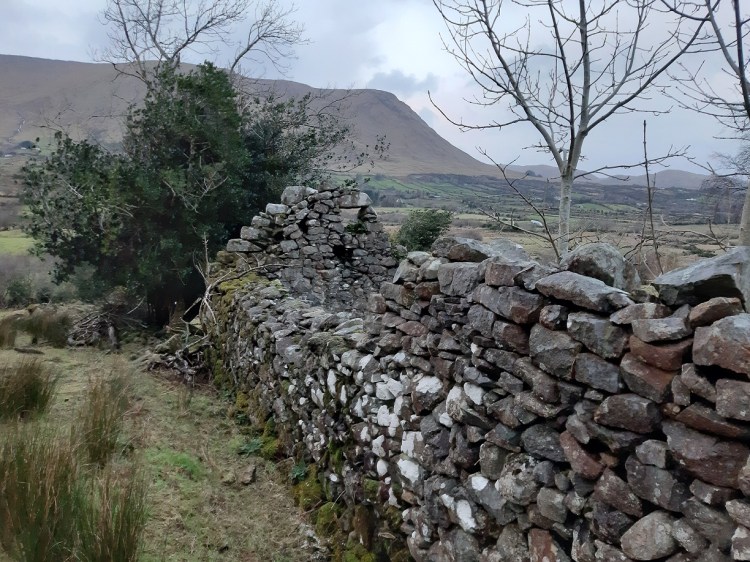
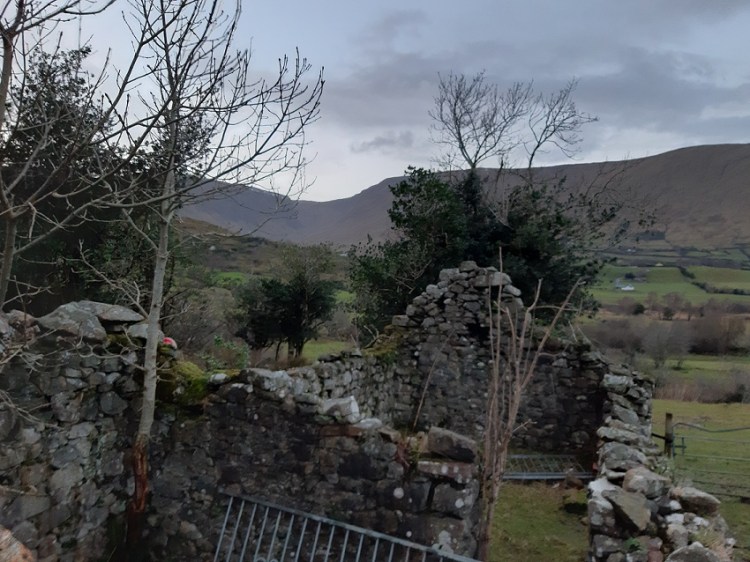
In January 2022 I visited the area where Maolra Seoighe lived to capture some of the photos used here. It’s an area of stunning natural beauty – even in the grip of the wild Irish winter. In 1882 it was an Irish-speaking area. I stopped 7 or 8 people for directions. All were English speakers; only two had any spoken Irish. The horrendous massacre in Mám Trasna claimed five lives. The trial took Maolra Seoighe’s, but it also symbolised the destruction of a culture.

Galway Cathedral has since been built on the site where Galway Jail stood. In 1943 Maolra Seoighe’s family sought to have his remains reinterred in Mám Trasna, but they were told his remains could not be identified. Maolra Seoighe’s body still lies beneath the Cathedral carpark. In a final irony, the memorial slab on the site where he died is in English only, the language through which he was accused, tried, convicted and executed – a language Maolra Seoighe did not understand.
Maolra Seoighe c.1842-1882. Neamhchiontach. Ar dheis Dé go raibh a anam.
-Article by Derek Hollingsworth April 2022
Thanks to Bob Downing (Dublin)

Sources/Further information
https://www.rte.ie/news/ireland/2018/0404/952165-mam-trasna/
https://www.irishtimes.com/life-and-style/people/a-wrongful-hanging-in-connemara-1882-1.2650574
Kissane, C. (2018). The Maamtrasna Murders: Language, Life and Death in Nineteenth-Century Ireland review. The Irish Times. Retrieved 22/02/2021 from https://www.irishtimes.com/culture/books/the-maamtrasna-murders-language-life-and-death-in-nineteenth-century-ireland-review-1.3719907
[1] Kissane (2018)
You can help by liking, sharing, or subscribing. If you wish to give something small towards the cost of running the site, you can buy me a coffee – go raibh maith agat!
Follow Me
Get new content delivered directly to your inbox.


Extremely sad the whole story, and the memorial slab is more like a final slap in the face, it’s insulting nobody cares. thanks for the post, go raibh maith agat.
LikeLiked by 1 person