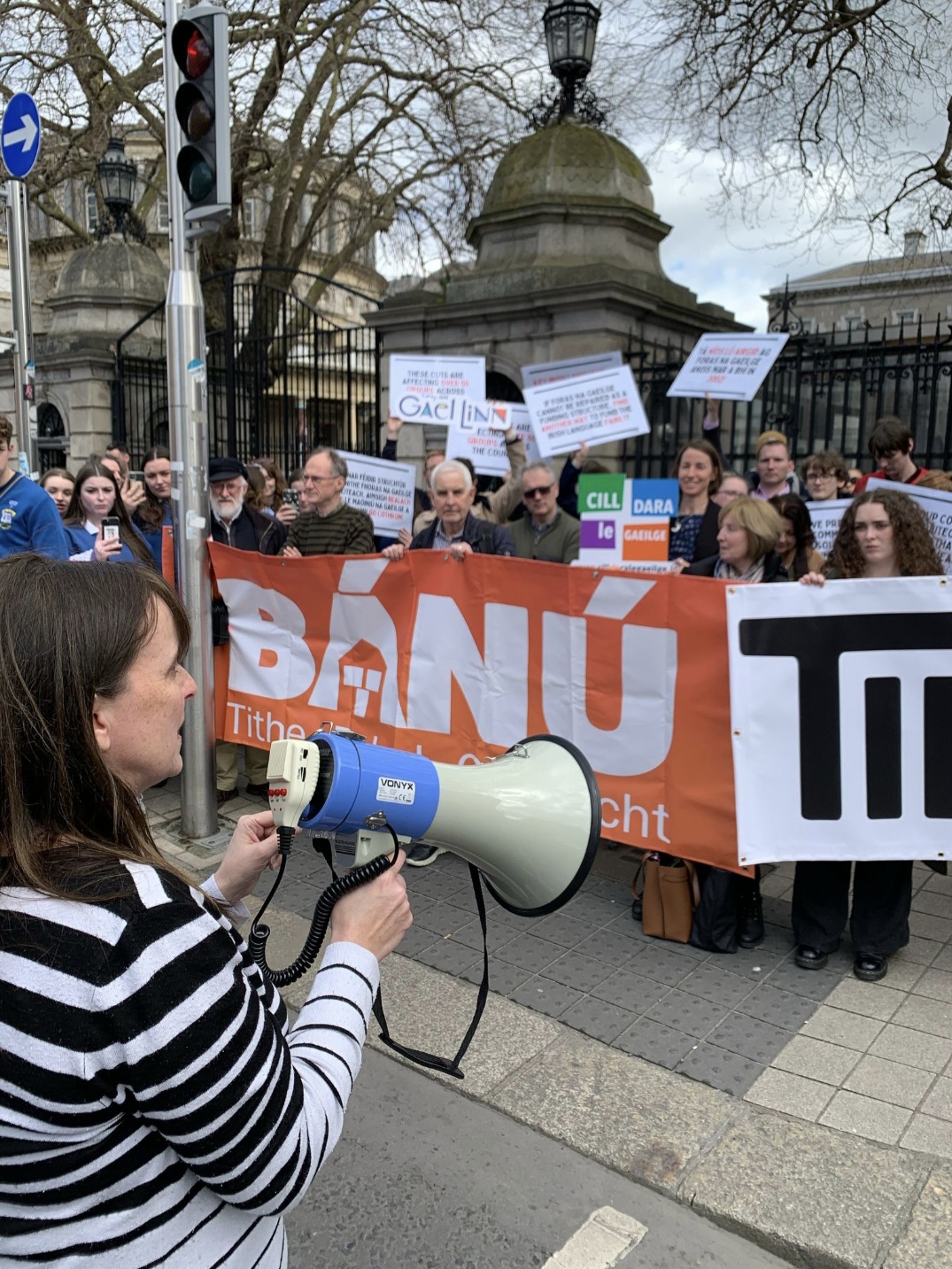
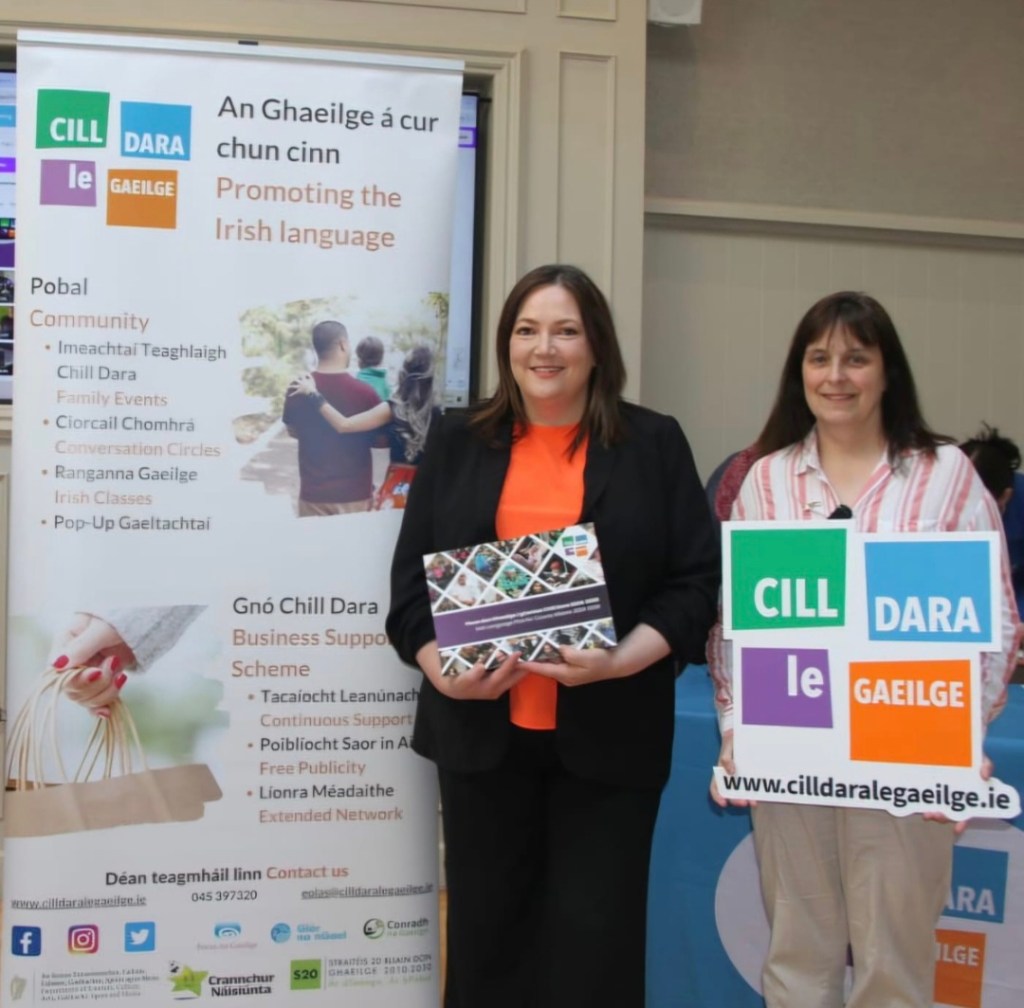
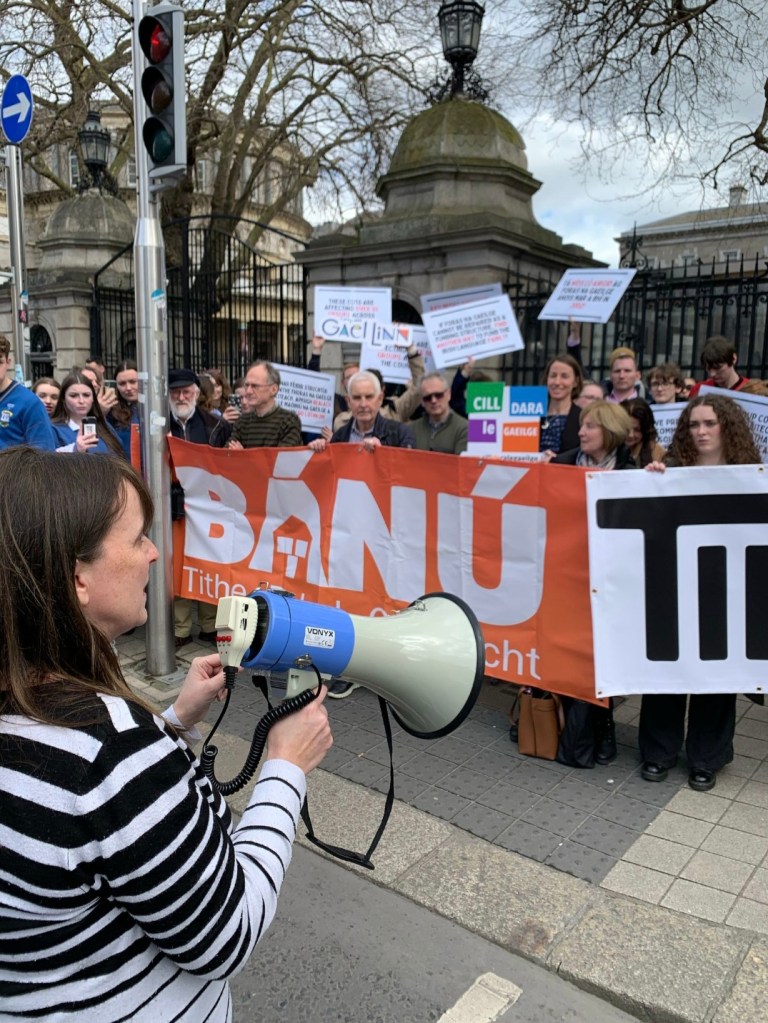
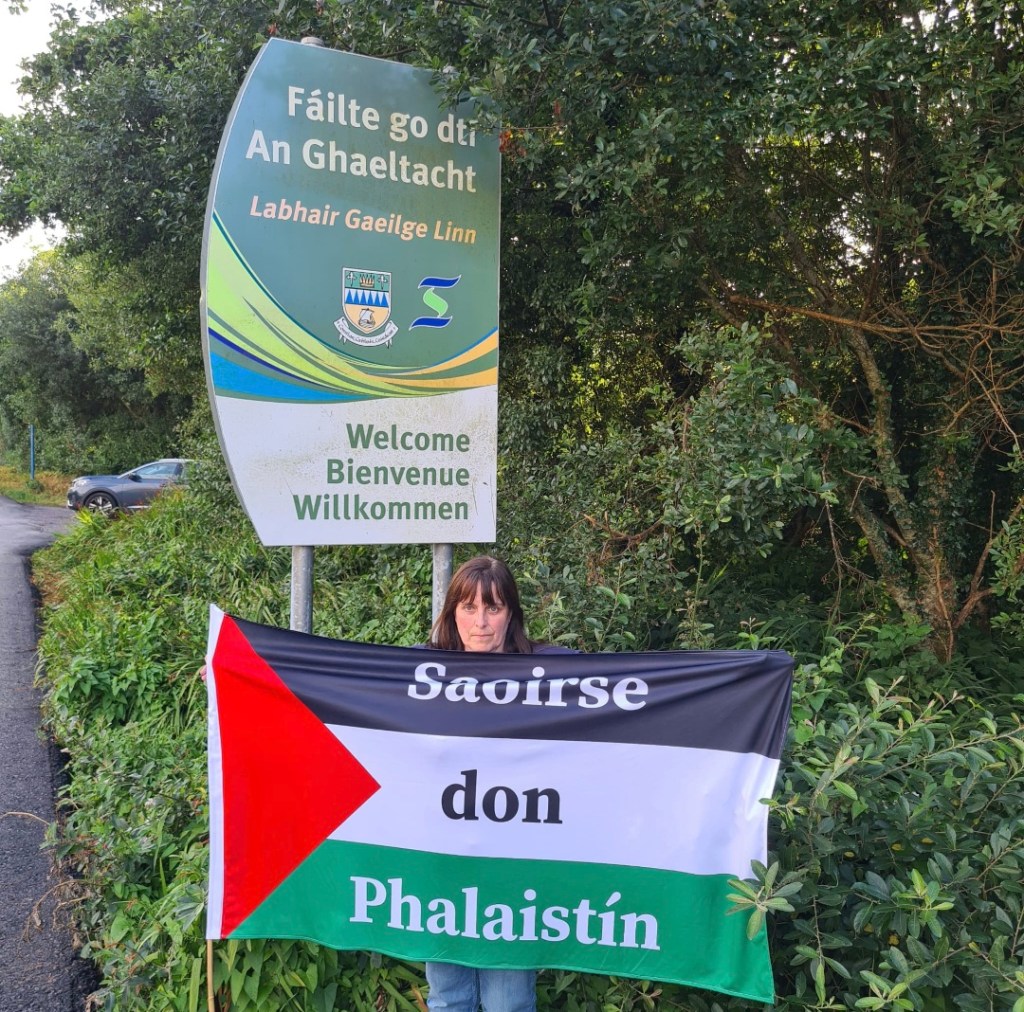
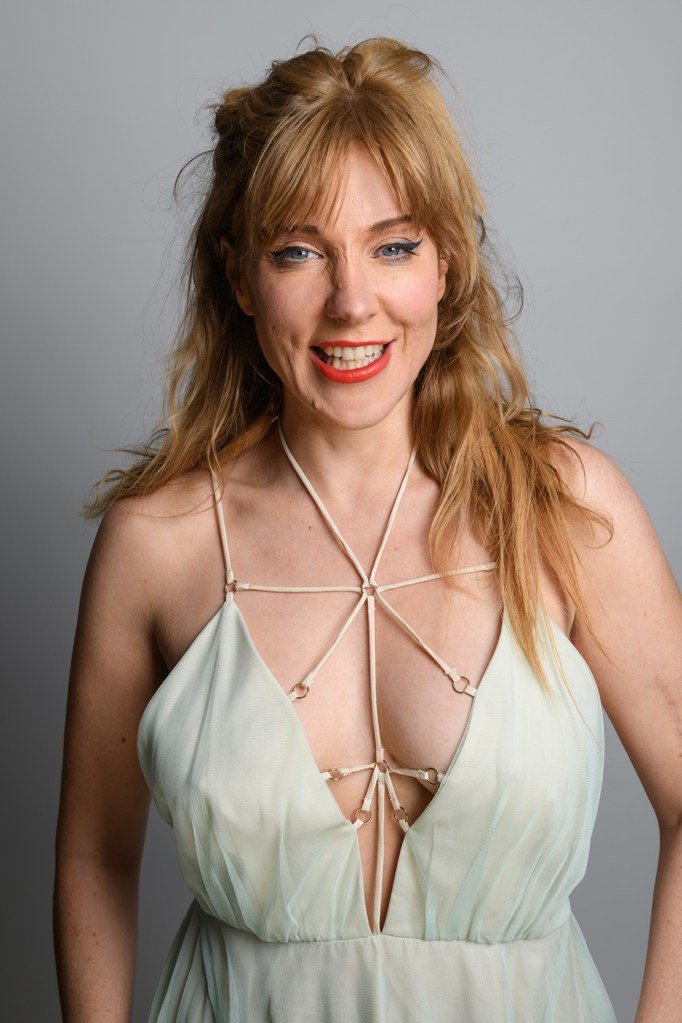
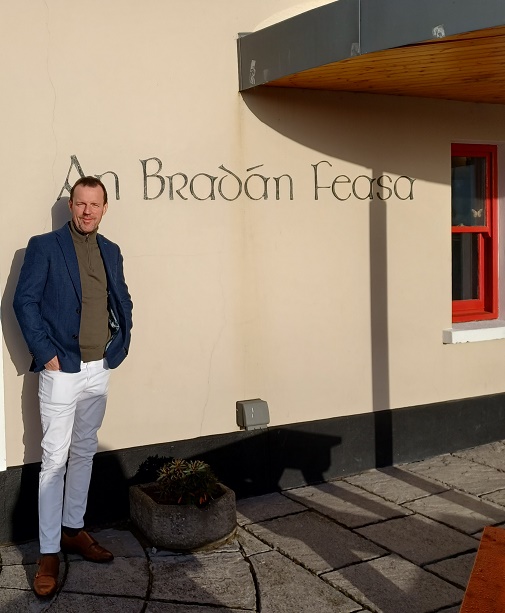
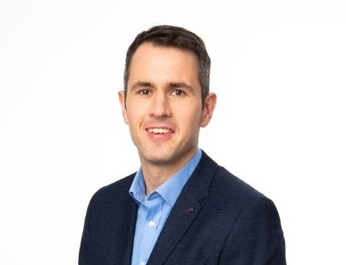
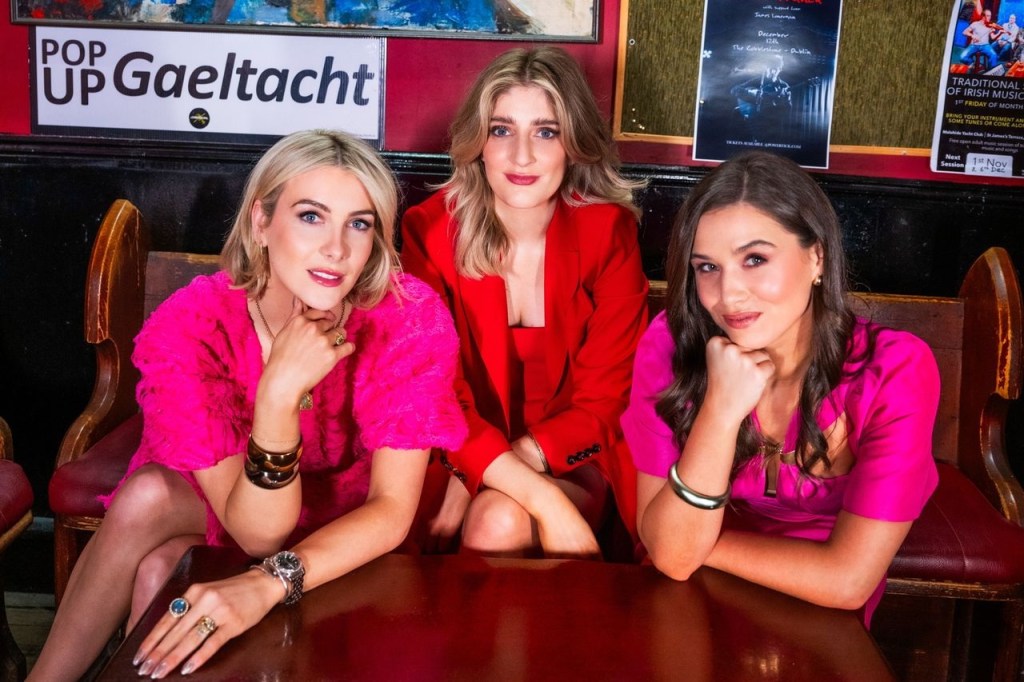
Siobhain Grogan, Cill Dara le Gaeilge (ar dheis) le Deirdre Ní Choistín, TG4
Cé thú féin anyways?
Is mise Siobhain Grogan, tuismitheoir triúir, cathaoirleach Chill Dara le Gaeilge agus Uisce for Gaza.
Cárbh as tú?
Tógadh i Nás na Ríogh mé agus táim fós ann!
Cárbh as do chuid Gaeilge?
Tháinig mé ar ais chuig an nGaeilge mar dhuine fásta. Níor thuig mé tábhacht na Gaeilge nuair a bhí mé ar scoil. Chuaigh mé go Coláiste Chamuis ag deireadh an 5ú bliain ar feadh trí seachtaine. Bhí sé ródhéanach chun m’ardteist a shábháil, ach thuig mé go raibh i bhfad níos mó Gaeilge agam ná mar a cheap mé. Thug sé misneach dom go mbeinn in ann í a fhoghlaim ina dhiaidh sin.
An bhfuil deiseanna agat do chuid Gaeilge a úsáid le déanaí?
Tá an t-ádh dearg orm. Labhraím Gaeilge gach uile lá. Thógamar ár bpáistí le Gaeilge agus bhog mé ó scoil lánBhéarla go scoil lánGhaeilge chun mata a mhúineadh seacht mbliana ó shin. Tá rud éigin an-speisialta faoi bheith i measc daoine óga agus Gaeilge á labhairt ag gach duine! Chomh maith leis sin, tá pobal láidir inár gceantar anois agus go leor daoine breá sásta Gaeilge a labhairt.
Céard atá ag tarlú leat go luath?
Táim díreach tar éis éirí as mo phost mar mhúinteoir! Mar sin, beidh tuilleadh ama agam do mo theaghlach agus d’obair Chill Dara le Gaeilge agus Uisce for Gaza agus b’fhéidir go mbeidh deis nó dhó eile amach ansin dom!
Tá Cill Dara le Gaeilge ag obair i dtreo aitheantas náisiúnta mar cheantar líonra Gaeilge do Nás na Ríogh agus na Sollán. Táimid ag obair le Comhairle Contae Chill Dara chun Cultúrlann Chill Dara a bhunú freisin. Tá sé an-tábhachtach go bhfuil áit shabháilte agus nádúrtha ann do dhaoine a gcuid Gaeilge a úsáid, is cuma cén leibhéal Gaeilge atá acu. Beidh béim ar leith againn ar dhaoine óga agus daoine nua sa tír freisin. Tá neart ar siúl againn!
Bunaíodh Uisce for Gaza i mí Lúnasa 2024 mar fhreagairt éigeandála ar an ngéarchéim in Gaza. Faraor, níl an ghéarchéim thart, i ndáiríre tá rudaí níos measa. Táim fíorbhuíoch as an tacaíocht in Éirinn agus thar lear a fhaigheann Uisce for Gaza? Rud spéisiúil ná go bhfeicim roinnt daoine atá gníomhach i gcoinne an chinedhíothaithe atá anois tar éis teacht ar ais chuig an nGaeilge mar go bhfuil tuiscint níos fearr acu ar an gcóilíneachas agus na himpleachtaí fadtéarmacha a thagann leis. Beatha teanga í a labhairt!
“I felt like I wanted to cut my fucking colonised tongue out of my head…’Why can’t I speak my own language?'” – David Keohan
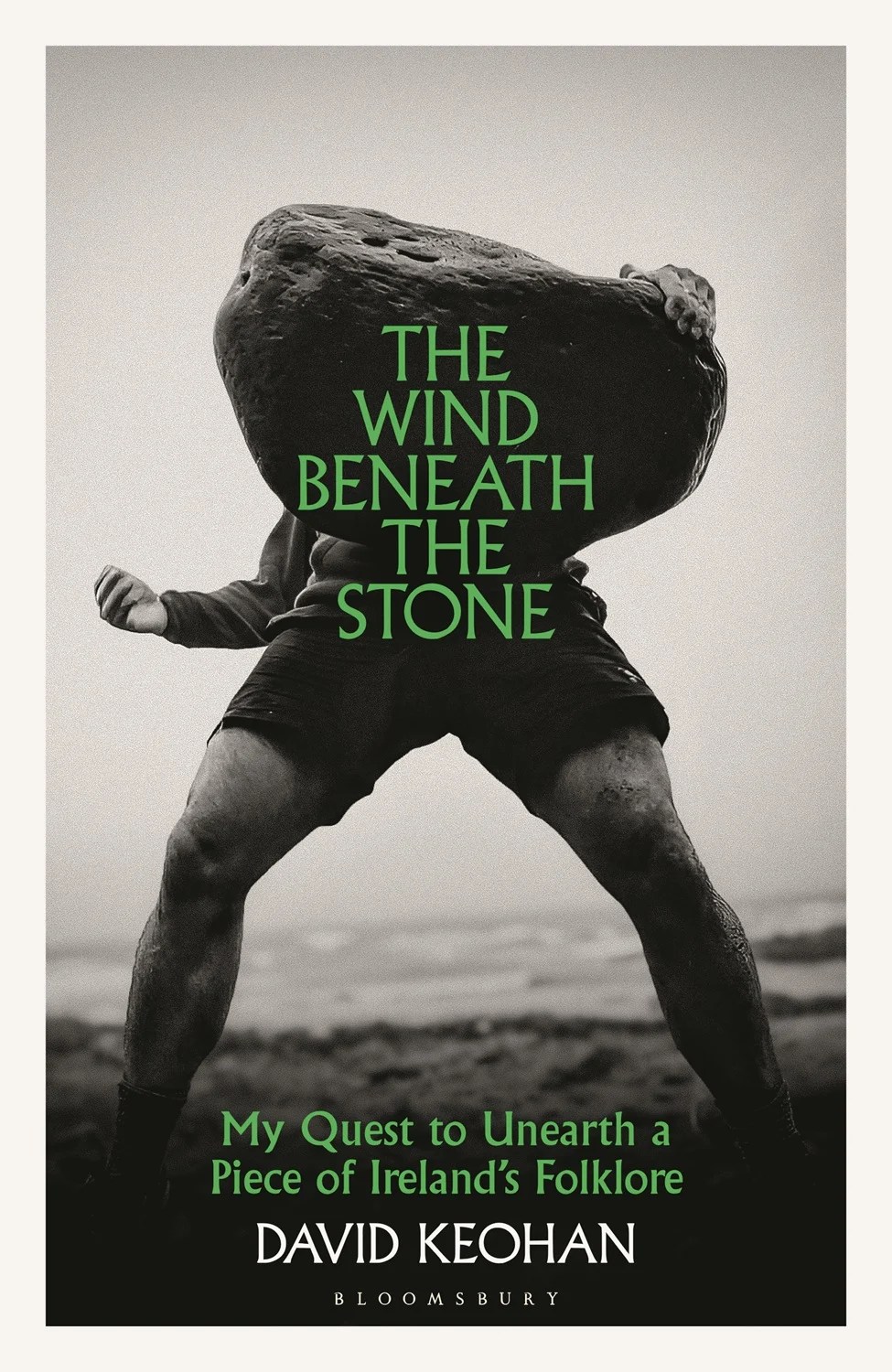
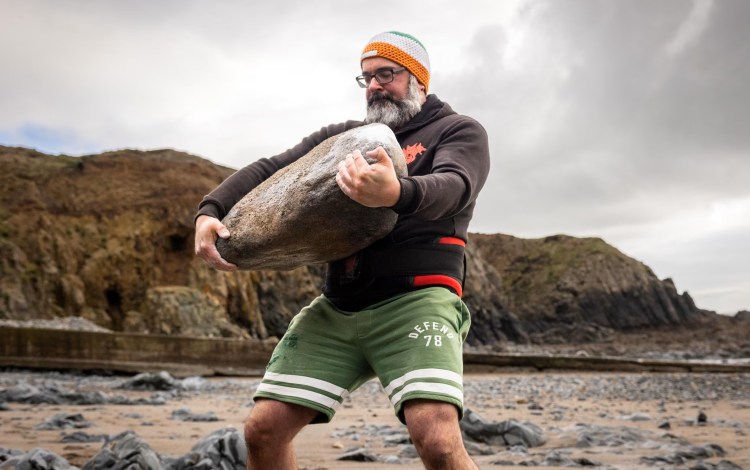
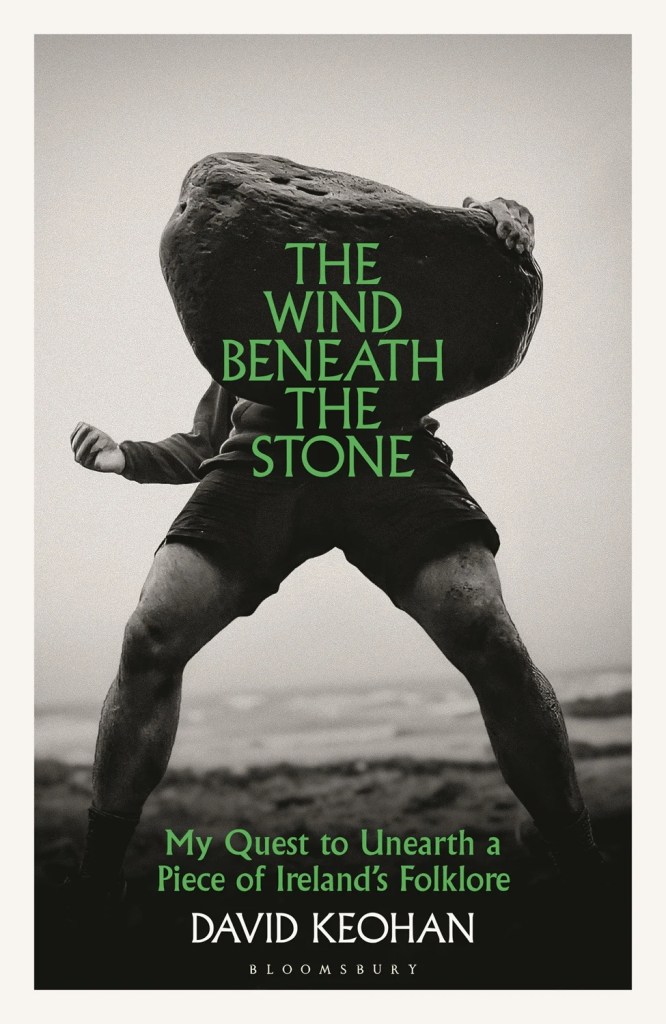
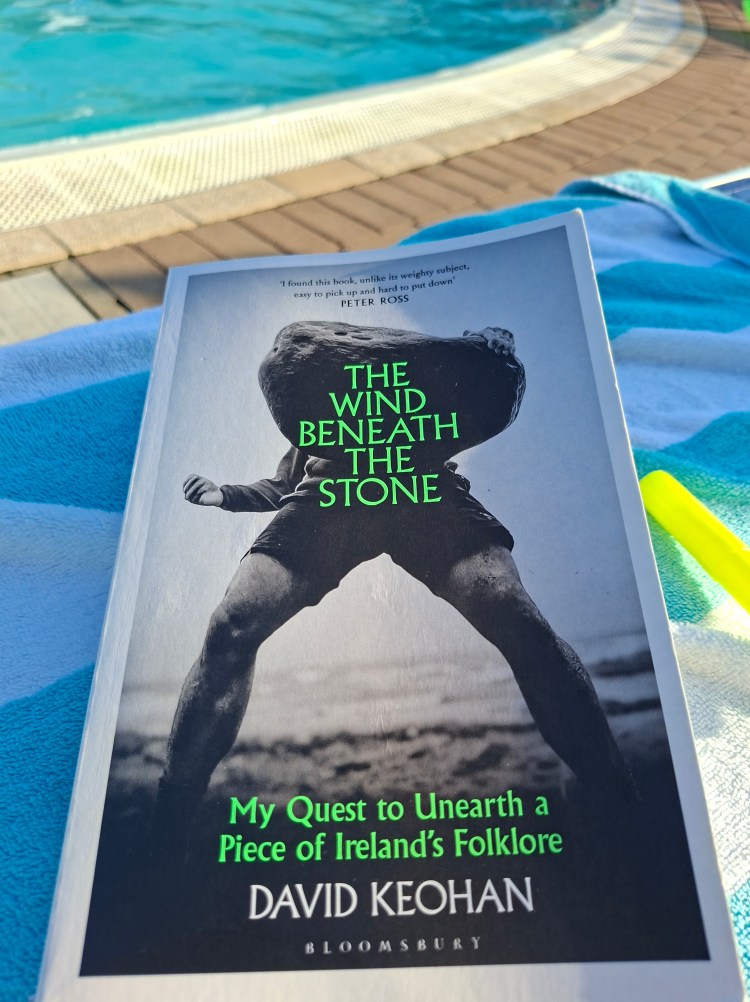
David Keohan, ‘Indiana Stones’, is a Waterford man. He is reviving the old tradition of stone lifting in Ireland and has recently published his book, The Wind Beneath the Stone.
5 minute read
Publication 7 of 2026
David Keohan. Photo by Johnny Savage, The Guardian
A chairde, I hope everyone enjoyed the Summer months and the long spells of good weather. Following on from my interview with Aideen McQueen (@ComedyMcQueen), this is a powerful story with David Keohan. Tá súil agam go mbaineann sibh sult as!
The pink granite rock shimmered as flakes of mica glistened in the light. Sitting in a hollow encircled by the blue-grey of the surrounding Inis Mór limestone, it lay just a few dozen metres from the rocky Atlantic shoreline.
David Keohan knew this was the prize he had travelled to see. The stone had an aura of its own – an energy that resonated with its history. David had come face-to-face with the Mullán Port Bhéal an Dúin. This was to be the first milestone on a quest of discovery and a journey of reclamation of culture, of language, and of self.
“The story behind these things is everything”
Unearthing a Lost Tradition
Keohan has become the leading figure in the modern revival of Ireland’s historic stone-lifting tradition.
Over the past four years, public interest in his work has exploded, particularly following an appearance on The Blindboy Podcast. Yet he believes the enthusiasm surrounding stone lifting is part of a broader picture.
He says his work has “landed in the landscape of Irish cultural revival”.
Stone lifting traditionally served a range of purposes:
Testing physical strength
Marking life milestones
Honouring the dead
Establishing local status and reputation
Preserving community stories and mythology
Keohan says, “The story behind these things is everything”.
The Search for the Mullán Port Bhéal an Dúin
Among Keohan’s most significant discoveries was the confirmation of the stone featured in Liam O’Flaherty’s 1937 short story The Stone.
O’Flaherty described a round granite rock whose mica particles sparkled in the sunlight. Keohan’s search eventually brought him from Waterford to Ros a’ Mhíl, then on the ferry to Inis Mór and to the village of Gort na gCapall. And there he found it.
The distinctive pink granite boulder immediately caught his eye. “Sin é.” he thought to himself. “That’s it.”
The stone is known as Mullán Port Bhéal an Dúin:
Mullán: a round granite boulder
Port Bhéal an Dúin: the mouth of the port of the fort
The fort itself refers to the iconic Dún Aonghasa, the ancient stone fort on the cliff tops of Inis Mór
For Keohan, the encounter was deeply emotional.
The stone had a “tangible presence”.
“You could feel an energy.”
“It spoke to me.”
He says he could sense the history contained within it, the generations of hands that had lifted it before him.
At the time, very few people remained aware of either the stone itself or the tradition that surrounded it.
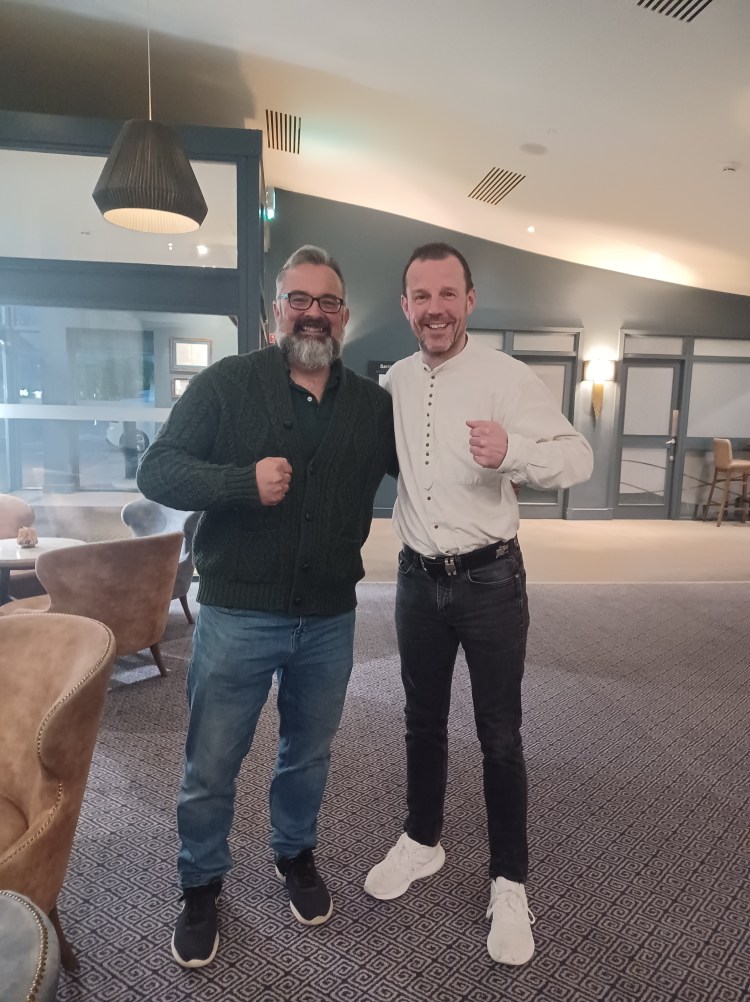
David Keohan & Derek Hollingsworth in Waterford, 2026
Four Years to Lift the Stone
The achievement took time and hard work. Keohan was unable to lift the stone during his first attempts. In fact, it took four years of training before he finally succeeded.
Relecting on the interest in his quest to locate these stones and their stories, Keohan believes that the public fascination his work has generated might not have been possible just five or ten years ago.
The Irish cultural revival, he argues, has provided fertile ground for renewed interest in traditional practices.
“It has rekindled the dying embers of a culture and the flames are being fanned.”
“It’s incredible. I’ve been to every county in Ireland now…we’re all just a bunch of sound lunatics who love telling stories”.
A Reclamation of Self & Culture
For Keohan, the search for lifting stones evolved into something far greater than a physical challenge. He describes it as a “reclaiming of self and my own culture”.
“It’s been the most incredible reclamation of self and reclamation of my own culture because, I mean, before that, I was never really into speaking Irish. I’d never gone to Conamara. I’d never travelled too far west. I’d gone to Clare a few times. I’d never been North. I’d never been to the islands. In the process of looking for these things, I’ve got back in contact to what it means to be an Irish person.”
The journey also transformed his understanding of the country itself.
“I’ve got to see the nation – the beauty of it. I’ve got to experience the beauty of the country that we’re lucky to live in and it’s amazing. It’s incredible. I’ve been to every county in Ireland now…we’re all just a bunch of sound lunatics who love telling stories.”
Learning Irish and Confronting Shame
Keohan’s travels brought him into regular contact with Irish-speaking communities. Those encounters also exposed a sense of loss he had never previously experienced.
“I’ve been to the islands, I’ve met the islanders. I’ve reclaimed part of my soul with this. Táim ag athfhoghlaim an teanga. Níl mé Gaeilgeoir. Bím ag dul go dtí áiteanna Gaeltachta agus cloisim daoine ag caint as Gaeilge. Tá sé go hálainn ar fad and níl mé ábalta caint as Gaeilge.”
He recalls visiting Gaeltacht areas and feeling disconnected from conversations taking place around him.
“I felt shit. I felt like a tourist in my own country.”
One particularly significant experience came while sitting with poet and seanchaí Seán Ó Coistealbha.
“And I was sitting there with Seán Ó Coistealbha – a wonderful poet and seanchaí – in the west, and he’s there chatting away with people and having to translate to me. I felt terrible. I felt like I wanted to cut my fucking colonised tongue out of my head. I felt awful. I was like, ‘Why can’t I speak my own language?’ And I felt an awful sense of shame.”
The experience gave way to contemplating childhood experiences of Irish as a school subject.
“But then I was like, it’s not my fault is it? It’s something I had to really delve into ’cause like it was taught wrong in schools. The system of teaching was terrible. It was taught as an exam subject as opposed to an actual language. We never spoke it in school. It was just ‘dom, duit, do, di…’ conjugation. It was a load of shite. You hated it because it was just a subject – another subject. You just didn’t understand it because you never spoke it, so I hated it in school and I never wanted to do anything with it ever again until that moment.”
“…to get back in touch with the language through this has been the most eye-opening thing ’cause I’ve seen how the language is connected to the land itself.”
Keohan says reengaging with the Irish language has fundamentally changed the way he sees the landscape around him.
“I was like, to know what this means fully, I’m going to have to start relearning the language, and to get back in touch with the language through this has been the most eye-opening thing ’cause I’ve seen how the language is connected to the land itself.”
He credits writer Manchán Magan as a major influence in helping him understand that connection.
“That was massive, and a lot of that was to do with Manchán Magan as well.”
As it happens, Manchán Magan had referred to the Irish word for stone in a 2015 article in The Irish Times:
“The disconnect between language and life in Ireland runs deep. There is something so evocative about calling a stone a cloch. There’s the knowledge that when our ancestors picked up the same stone thousands of years ago, this was the term they too used. Cloch is the word our people chose, and we’ve been using it ever since. It’s not a stone, not to the people of this island, anyway. Cloch is what it is.”
In his own book, David tried to both remember Manchán and respect the language by including its original pre-manglicised native placenames.
“In the book that I wrote…as a deference to Manchán, everywhere I went I not only wrote the English name in, I wrote the Irish name into the book, and the meaning behind the Irish name.”
“And then that opens up your eyes to so much. I’m training on Benvoy and it’s like An Bhinn Buí, ‘Melodious Yellow’. I used to live on the Copper Coast and you’re looking at the yellowness of the cliffs and the melody of the sea coming in against the cliffs – that’s a fucking amazing name! Benvoy means nothing but An Bhinn Buí means everything.”
He points to other examples:
Fionnúir (Fennor): “White side of the hill”
Cluain Meala (Clonmel): “Meadow of Honey”
“My favourite one in Ireland is Clonmel: Cluain Meala, ‘Meadow of Honey’, what a name. That’s incredible. Why weren’t we taught this in school? That’s inherently interesting.”
Making Irish Meaningful Again
Keohan contrasts his own school experience with the way Irish is taught by people like Seán Ó Coistealbha.
“Táim ag caint le Seán Ó Coisdealbha. Tá sé Gaeilgeoir agus tá sé ina chónaí i gContae na Gaillimhe. A Fulbright Scholar, he went to America teaching Irish. He’s teaching Irish mythology and poetry. That’s brilliant. I love mythology and poetry is beautiful and he’s teaching through that. It’s making it interesting for people, you know? No one wants to learn conjugation.”
The conversation has also led him to consider language revitalisation efforts elsewhere.
“I’m talking to people in Wales about this thing. What’s it, 17% of people in Wales speak Welsh? You just start in school. You just have a class and just speak Welsh. All of a sudden, everyone’s speaking it. Can we do that here? Why can’t we do that here too?”
This article is based on excerpts from a much longer interview that will air in full on an upcoming podcast, Irish Language Matters – Decolonising the Focal.
During the conversation, David Keohan talks about the post-colonial shame attached to aspects of native Irish culture during his upbringing and the extent to which attitudes have changed in recent years.
We discuss how his quest to rediscover Ireland’s stone-lifting traditions became intertwined with a larger cultural movement, one that has helped many people reconnect with aspects of Irish identity, language and heritage that had been shunned or neglected.
David’s book, The Wind Beneath the Stone, published by Bloomsbury is out now across Europe, and is a very enjoyable read. It will be published by Chelsea Green in the United States in September.
David, a chara, go raibh míle maith agat arís!
Follow Irish Language Matters on Social Media, links below
If you wish to give something small towards the cost of running the site, you can buy me a coffee – go raibh maith agat!
“…everyone’s more comfortable being themselves. So now we can come out as a Gaeilgeoir as well.” – Aideen McQueen
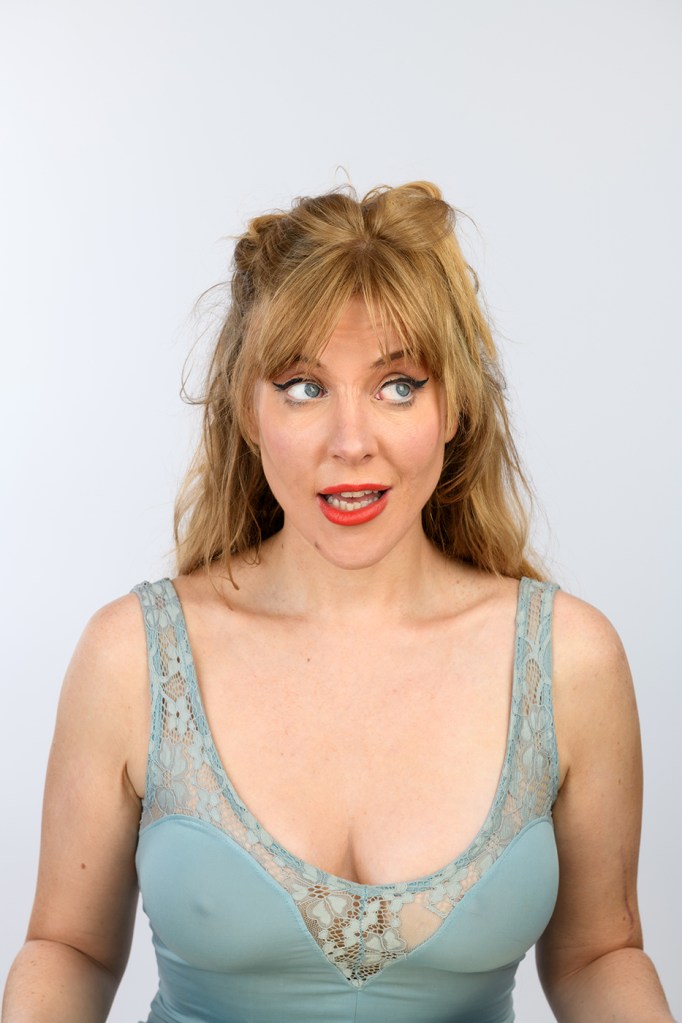
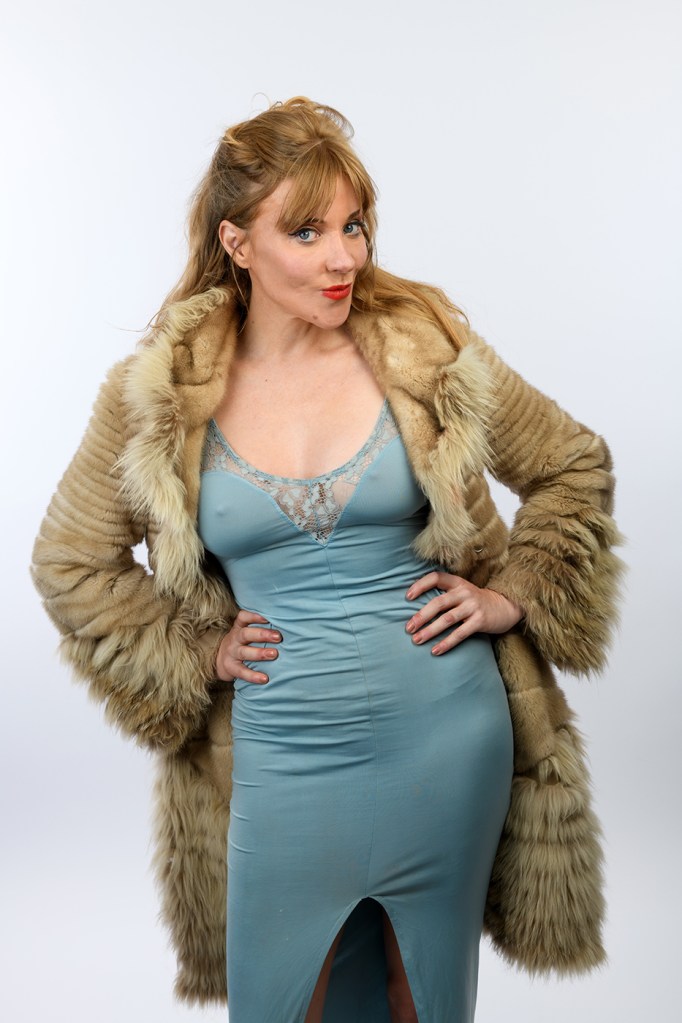
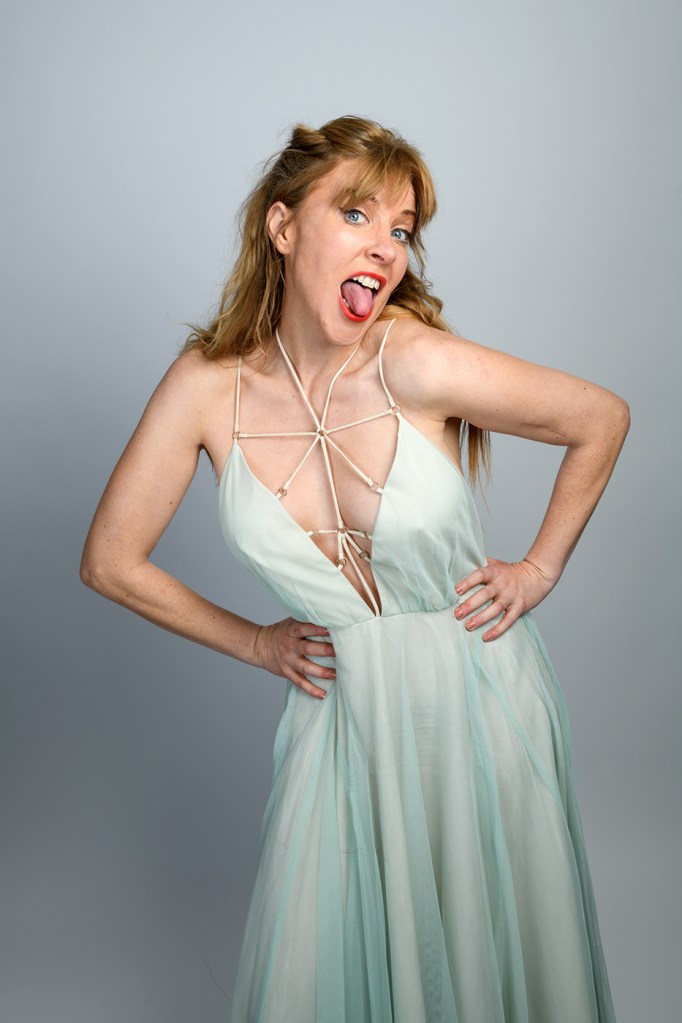
Aideen McQueen is originally from Kilkenny. One of Ireland’s top stand-up comedians, Aideen is currently gigging her solo show, Waiting For Texto.
Publication 6 of 2026
Aideen McQueen
A chairde, I hope everyone’s enjoying the Spring after a long Winter in Ireland. Following my interview with Mollie Guidera (@IrishWithMollie), here’s another really interesting one with Aideen McQueen (@ComedyMcQueen). Tá súil agam go mbaineann sibh sult as!
Cill Chainnigh le Gaeilge
Irish Language Matters (ILM): Aideen, where’s your Irish from – did you have it in the home?
Aideen McQueen: Yeah, so my Dad was an Irish teacher. He didn’t speak Irish at home but he’s from South Kilkenny, so Ballyhale, hurling country – Henry Sheflin, T.J. Reid, a lot of the greats and you mightn’t know this but the last native speakers in Leinster were in Louth and Kilkenny. So, the last native speaker in Kilkenny died in the 1940s. He was in his 90s. So that’ll just tell you that the language doesn’t disappear in one generation.
My dad’s parents would have been born before Ireland was independent so my granddad was born in 1898 and my grandmother in 1913. They would have been educated in the old British system. They didn’t learn Irish in school but they would have had a lot of phrases – even some full sentences in Irish – and a lot of words. So my dad would have heard a lot of Irish and he always loved the language and so he got a scholarship to become a priest, he went to Maynooth and he studied Irish. Then his own father died and he had to go back on the family farm and he left the seminary, but he was educated so that was great at the time in the 1960s – and the free education came in – so he became a teacher and he taught in Kieran’s college, the home of hurling. I don’t know if you follow hurling?
ILM: Not really.
Aideen McQueen: Where are you from?
ILM: Templeogue originally. [Faughs and St Judes GAA clubs are there. My mother’s actually from Bonnetstown, Lacken, Co. Kilkenny]
Aideen McQueen: Kieran’s would be one of the places where hurling’s very strong. Everybody went there. But he was a teacher up there. Then, when I was born – he didn’t discuss it with my mother – he just started speaking Irish to me and then two other sisters so we only spoke Irish with my father, with my mother we spoke only English. She has school Irish but with my Dad it was all as Gaeilge, which at the time was really unusual. He might as well have been speaking Latin in Kilkenny. But, sure then of course that was great ‘cause I always had Irish then, so second nature – first nature really.
ILM: I was aware of Omeath as being the home of the last native speaker in Leinster [Anna Uí Annluain or Anne O’Hanlon of Omeath d.1960, recording of Anna speaking Oriel Irish] but I wasn’t aware that Kilkenny lasted that long.
Aideen McQueen: South Kilkenny, yeah, and they have recorded the last speaker [Pádraig Paor or Patrick Power of Glenmore, d. 1939 or 1942, written text available from Dúchas.ie] in the forties he’d a very different accent. The ‘r’ caol, so they present an ‘r’ as ‘s’, so Éire was Éise.
ILM: Would this have been similar to the Munster dialect, then?
Aideen McQueen: No. Surprisingly, different to the Munster dialect. Not totally different but a lot of differences and there’s books on it. You can look at all the phonologies and the ways it was spelled but there was a Leinster dialect that was separate and maybe even a little bit like what they spoke in the Isle of Man.
ILM: All of that is really interesting – the language shift and the different times it happened in different counties, and so on.
Aideen is currently touring Waiting for Texto
Shame, and The Grift
“He’s Church of Ireland, very nice!”
IrishLanguageMatters: I’ve heard some people raised with Irish saying that there was this sense of shame or embarrassment for being different when they were teens or the early 20s or whatever, and I think that’s really interesting – the amount of psychological baggage we have in relation to the language.
Aideen McQueen: Yeah, there would have been. I did a programme with a star of TG4 more than 10 years ago and they would always speak English to you whenever they could, like the cool person that they are, and I was like, “Come on”.
ILM: Really?
Aideen McQueen: Yeah, I’m sure they’ve probably changed now ‘cause more people are speaking it, but yeah even people in the Gaeltacht have that. They used it as, “I can get into college. I can do primary school teaching”, like they used it when they had to and they used it for TG4 but then they weren’t really that wa-woo with the teanga…
ILM: So, it was like an economic vessel?
Aideen McQueen: I think a lot of people, it’s a bit of a grift for them, but now like outside the Gaeltacht people are really getting into it, so yeah, I’m sure they were embarrassed because I could see them being embarrassed by it, or just always wanting to go to English. So yeah, it would have been like we would have like we’re speaking Irish and other kids were going “Are you speaking Irish?” and then they try to make you say stuff and they couldn’t really quite believe it – what does this mean and what does that mean? “What’s penis in Irish?” Older boys like kind of bullying you but it’s changed. My sister now is raising her kid, Aifric, as Gaeilge – she’s only a year and-a-half. My sister married someone from the Church of Ireland, so she’s done well.
ILM: Married into money?
Aideen McQueen: She did, in fairness to her, or as my mother says (whispers) “He’s Church of Ireland, very nice!”
ILM: I’m sure you get a lot of material from this!
Aideen McQueen: I wouldn’t do it – she’d kill me. She’s now speaking Irish to her kid and we all speak Irish to Aifric, and in fact your man is good at languages so he’s picking it up, like he’s open to it even though he would have gone to one of the rugby schools where they don’t emphasise it.
Follow Aideen on Instagram @ComedyMcQueen
I was like, “Oh my God they’re going to bully us now. They’re going to steal Aifric’s lunch money and they’re gonna invest in their stock portfolios”.
Changing Attitudes, and Class& the Irish Language
Aideen McQueen: We were down at this very posh Dublin 4 like David Lloyd, it’s like a really posh gym with the David Lloyd kids, and we’re down at the balls and we’re ag labhairt le hAific as Gaeilge agus ag súgradh agus ag spraoi agus ag imirt, and all these kind of Dublin 4 girls, you know the cool girls? They’re about 7. They came over, and I was like, “Oh my God they’re going to bully us now. They’re going to steal Aifric’s lunch money and they’re gonna invest in their stock portfolios”. I don’t know what they do in Dublin 4. And they’re like, “Are you guys speaking Irish?”, and I was like yeah, yeah. “I know Irish,” and then they weren’t in a Gaelscoil but they started coming out with loads of phrases and we were ag caintas Gaeilge and we’re having a great craic.
Even 10 years ago, children didn’t like Irish that didn’t go to Gaelscoils but now they were very positive towards it and in a place where I would have thought… ‘cause economically Irish is kind of the language of the working class and the lower middle class. Irish was an opportunity for you to get into university, Irish was an opportunity for you to get into the civil service, you could be a teacher; so it was a leg-up for people that were working class or lower middle class. There’s two Gaelscoils in Baile Munna (Ballymun) for instance. But the upper class and the upper middle class – the solicitors, the barristers, engineers, doctors; people who go to rugby schools – they don’t need Irish, and they don’t emphasise it at all. So they would generally be like looking askance at you if you spoke it, but that (experience) was like, “Oh, they do have a positive attitude towards it”, so that was good.
ILM: Yeah, there’s definitely a bit of a shift. It’s funny when you go to Belfast, the perception of some at least is that the Gaelscoileanna movement in Dublin is very much middle class, and that’s not always the case, as you said.
Aideen McQueen: No, it’s not. I mean there’s definitely – I did a sketch on my Instagram about the mother who’s trying to get a kid into the Gaelscoil, “The Gael School”, and she’s totally faking her interest.
ILM: “Rían with the fadas”?
Aideen McQueen: Yeah, but there’s a lot of normal kids, there’s black kids, there’s Polish kids, there’s all sorts of kids in Gaelscoileanna as well. I was in the Gaelscoil in Coolock. It’s just that there isn’t enough of them and the government don’t really care about it, and the government might put a bit more emphasis on Educate Together at the moment ‘cause that’s more kind of fashionable, I think.
But to start up a school it takes a lot of effort. Hopefully it’ll keep growing because the demand for it is high. People would love to send their kids to the Gaelscoils. And then people are scared to send a kid to a new school, ‘cause you will have one teacher in room. Like with my dad was involved in starting a Gaelscoil in 1984 in Kilkenny. The Gaelscoil was in a hall in O’Loughlin Gaels GAA club, and the teacher, Múinteoir Siobhán, who taught me, every morning she’d have to pick up cans and cigarette butts, ‘cause the GAA club is also the bar and everything like that. It was totally unsuitable. There’d be men coming in and out. So, it’s a bit of a leap sometimes, yeah.
ILM: Absolutely. When my kids started in their Gaelscoil there was a portacabin – mice, frogs, plenty of wildlife for them to enjoy – but yeah it took years for the building to come about.
We should see it more as a game, as fun, like a music rather than a language…
So yeah, psychology is my background and what I find fascinating is that there’s this, like I say, there’s baggage, maybe shame for people speaking publicly or whatever – at least in the past. There’s also shame for learners like myself about not having it. So, you kind of get it on both sides.
Self-hating Irishman syndrome & Irish as Music
Aideen McQueen: I think that’s a lot of self-hating Judaism or self-hating Irishman syndrome. Irish language speakers don’t care that you don’t speak Irish really. It’s the way the guitar players don’t care if you don’t play the guitar. They’re not like, “Oh you’re not playing an instrument?”. Like Irish is a dead language really, which is also its gift.
ILM: In what sense?
Aideen McQueen: Because if the language is not really used – it’s not necessary for administration, it’s not necessary in the court of law – it can be used, but that gives you a great freedom. If it’s a dead language then it becomes a living music, it becomes something that we can only enjoy. It becomes something that we can make mistakes in. It’s something that we can evolve. It’s something that we can break the rules of. If you don’t put the ‘h’ in the right place, it’s not like [plays drum riff on the table], “Oh no, that’s terrible”. Like, who cares?
So, we should see it more as a game, as fun, like a music rather than a language, ‘cause we’ve got freedom to play with it, ‘cause we don’t really have to have it, and that’s a scary thing for people to kind of get their heads around. But we can embrace that, and maybe not to be so rigid in the gramadach and so rigid in the spellings and things like that. That it’s a living, breathing language, that it’s fun; and that it’s to be enjoyed, not endured. Like, it’s hard for learners, they come and they think “Oh, I’m going to be totally judged”, like everyone is this Gaeilge Nazi and “Ó níor chuir séimhiú ar sin tut tut tut”. People aren’t thinking like that, and if they are they’re probably autistic, so God love them.
Aideen is currently touring ‘Waiting For Texto’
It’s a Kneecap nationalism more for the show of it rather than you’re actually learning this in the H Blocks.
A More Accepting Society
ILM: There seems to be fewer [people who are rigid about use of the language] now than there may have been in the past.
Aideen McQueen: ‘Cause we live on an island so we don’t hear people speaking other languages in the way that European’s do.
ILM: Immigration has actually helped.
Aideen McQueen: Yeah, it has helped. So immigration is a help ‘cause we hear other languages and we want to speak our own language and the other thing that’s helped, I think – and it’s quite an interesting theory – is that people are all coming out now. Everybody is identifying as “I’m autistic”, “I’m neurodivergent”, “I’ve ADHD”, “OCD”, “dyspraxia”, “I’m gay”, “I’m bi”, “I’m non-binary”, “I’m pan”, “I’m trans”, so everyone’s more comfortable being themselves. So now we can come out as a Gaeilgeoir as well. I did a thing a few years ago before COVID where I was like, “I’m going to use a word of Irish with everybody I meet on the street”, for everyone I meet, even in a siopa and I’d be so embarrassed. It would be nearly more embarrassing to say “Go raibh maith agat” to an Irish person than to a Polish girl in the shop. I felt like I was in the IRA or something, just, “Go raibh maith agat,” code.
Yesterday I was in Gay Spar, and I bought like a Fulfil bar after my gig – a little treat – and the guy behind the counter just said “Slán” and I was like “Oh, slán!” like that would have been weird even five years ago – for an unsolicited ‘slán’, like I’m not wearing a fáinne or anything. He doesn’t know who I am. There’s more self-acceptance in general so I think that ties into the Gaeilge thing.
ILM: Yeah, so there’s a lessening of the previous associations that would have been there, say with nationalism, with poverty, with backwardness, all this kind of stuff…
Aideen McQueen: Yeah, I think those ones have truly gone. The nationalism one – yeah that’s pretty much gone, I think. There’s still an association, but it’s a different kind. It’s a Kneecap nationalism more for the show of it rather than you’re actually learning this in the H Blocks.
ILM: Have you ever felt any sense of shame or embarrassment or pride? Does it bring out emotions in you to use the language?
Aideen McQueen: When I was teenager, I would have felt embarrassed because I was painfully susceptible to other people’s opinions of me – the disease of being adolescent – and I would have been embarrassed sometimes, yeah and not really wanted to speak it in public. Yeah, now I’m proud of the language, it’s great, I really enjoy speaking it so it’s come full circle.
ILM: I’ve heard that from an awful lot of people. There’s that self-consciousness anyway in adolescence. I think sometimes it takes a little bit of self development and maturity to reflect on maybe what’s important in life, and you don’t really fully get a grip on that until you are like in your 30s or your 40s or whatever.
The Language in Culture
So, where’s the language going to next? I suppose, some of the milestones you could see in the past would be like the Gaelscoileanna movement, the Pop-Up Gaeltachtaí, the Coláistí Samhradh, things like that, the Kneecap effect and social media. People like yourself using Irish on Instagram or whatever. That has an influence for people like me who are trying to bring Irish into our lives where Irish wasn’t there before. All of those things are kind of signs and signifiers that this is OK and it’s good to be part of this. It’s positive even if you’re taking the piss out of Gaelscoil mothers or whatever.
Aideen McQueen: If I watch let’s say maybe Mexican-American comedians or South American comedians that are speaking in English, they’ll throw in loads of Spanish. You still feel like you understand it, ‘cause you can get the gist; or Indian comedians they’ll be like half-English, half-Punjabi, so other cultures have much more natural way with bilingualism. In Ireland I think we’re like, “Tá mé ag labhairt as Gaeilge. Now I’m speaking in English”, and people they don’t kind of throw in words, and I think, how do you get a whole nation to kind of be a bit more…like maybe set yourself a challenge, like I’ll speak one word of Irish or put one sentence into everybody I speak with or, you know? We know more than we realise. You can use it all the time, and why not? It’s good for your brain as well.
I think it’s good. Some of it is tied into the “Ireland for the Irish,” a little bit, but look, most of it isn’t as far as I can see. I think with Brexit as well I think we’ve really wanted to mark ourselves out as different from the English – the British really. I mean there’s an affinity with the North as well where that works that way too. I’m very positive, tá mé dóchasach as an todhchaí i nGaeilge.
ILM: Sin go maith. I think when you see @FenianWarrior1298 on Twitter, usually they haven’t got a ******* word and it’s just a stick to beat somebody else with.
Aideen McQueen: Yeah, it is yeah.
ILM: When you see these suggestions that like immigrants should have to pass a test in Gaeilge, well maybe people born here should have to pass a test in Gaeilge as well?
Aideen McQueen: I don’t really be on Facebook that much anymore, but I remember yeah few years ago I was getting all these friend requests from men but they’d have an Irish flag or a shamrock and I was like “Oh yeah, the Gaeilgeoirí” and the name as Gaeilge and I’d be like “Oh, glacaim le…, glac, glac, glac, glac,” and then I looked, I was like “Oh ****”. These guys, I thought it was nothing to do the Irish language at all. Yeah, that was all creeping up then but, yeah, it’s generally positive.
Aideen McQueen: I think we need to wear it like a loose garment. It’s not perfection that you’re looking for. It’s like music, everybody can enjoy it. You don’t have to be a concert pianist like, as in a fluent speaker, you can just play the spoons at a session and then throw in a few words. We all can enter the session at our own level and sing along with the Gaeilge. So I think it’s just changing our attitude from rigidity to improvise music. It is not something that has to be scored.
Vegan, Vegetarian, or Gaeilgeoir?
ILM: Is it important to you to use it in your work?
Aideen McQueen: It is, yeah. I like to use it, and it’s become more and more acceptable. People are now impressed by it rather than kind of “Oh…” It’s a bit like telling people, “Oh yeah, I’m a vegan”. I’m not a vegan but if you tell somebody that you’re a vegan, or tell someone that your fasting, or tell someone that you got up at 5:00 for a run, they’re like, “Oh, oh, why do you do that?” ‘cause in their mind they feel almost accused or attacked by it. So, if you said you’re a Gaeilgeoir and you’re fluent it’s like “Oh ****”. They feel like “God, I should be fluent, I should be going to the gym”. Some people see it as another thing they should be doing in this list of things that we should be doing in the world. I do like to use it, yeah.
ILM: I have a funny experience on what you’re talking about. So, I’m vegetarian…
Aideen McQueen: Yeah, some people just don’t like it. They’re like “Oh, what?!”
ILM: Yeah, and I’ve had to think about this. I’m like, why do people get so aggravated? They feel challenged.
Aideen McQueen: I think if people are aggravated probably they feel challenged by it. “Like, what if the chicken was about to die – would you eat it?” They ask, “How long have you been vegetarian?” and, “Why did you decide to do that?” or, “Is it because you love animals?” I can imagine there’s millions of questions.
ILM: You just want to sit there and eat your ****ing food at the wedding or whatever it is, and people have to interrogate you because you’ve triggered something in them. There’s a little insecurity.
Aideen McQueen: Yeah, because I don’t drink, I’m a recovering alcoholic and most people don’t bat an eyelid. They don’t care. In Ireland, everyone has somebody that doesn’t drink. But there are people like, “Why not? Would you never drink? What happened?” You’re like, “OK, you’ve got a problem”.
Yeah, the Gaeilge thing, people can be a bit weird about it sometimes. “Is it not a dead language?” that kind of stuff, and “Would you not be better off learning French or German or Spanish or Mandarin?” Yeah, if I was going to learn music I should probably learn the guitar. That’s the most common instrument but, if I have to play the oboe it’s still good. I can still join in.
ILM: Yeah, like go right ahead. If you want to learn Mandarin, you go ahead and learn it. It’s funny the way they’ll put that to you, but they’ll never go and actually learn Mandarin themselves.
Aideen McQueen: No, they won’t, and actually if they were going to go to Mandarin classes, I bet I’d pick it up faster as I’ve already got an extra language in my head. But there you go. It’s interesting. It’s funny. It’s normally more upper middle class and upper class people that kind of question that. A lot of those people’s mentality is money orientated, so education is to produce money, so why would you get education in something that was…you know? But if you explain to them that Irish is kind of an art, then they can kind of buy in to it.
ILM: I’ve a friend who’s a really lovely guy. His parents were ‘cruel’ when we were kids as far as we were concerned because his parents made them study, whereas our parents let us run amok. The fact that they had to study we saw as an awful imposition on them. Anyway, his parents would have had that mindset that there was a utilitarian aspect to school. Get a good career etc. So, he’s a professional now. I think he regrets his parents attitude [to Irish] and the way that rubbed off on him. He saw education as a means to a career and only that. He’s like, “I’d love to be able to speak Irish”, now. In his way – as he has very little Irish – he will use whatever he has with his two little girls and it’s lovely.
I think attitudes are changing and that’s a good thing. I think we see beyond that – school is about creating clones for industry – I don’t think we think like that anymore. It’s more holistic. And let somebody [children] develop what they’re good at and interested in.
Aideen’s Upcoming Shows
Tell us what’s going on for you at the moment. You were in Galway at Easter.
Aideen McQueen: Yeah, so Good Friday I was in Galway [Sold Out] doing my solo show, Waiting for Texto. I’ve got two solo shows in Dublin on May 3rd. They sold out so I’m doing an extra one May 31st – which is exciting – in Whelans. I’m going to Béal Feirste on May 8th as well to do it and I’ve got few different ones popping up.
Aideen McQueen or @comedymcqueen on Instagram. I’m on Facebook. A little bit on TikTok, but Instagram is the best place to catch it, and there’s a link to all my shows. Greystones will be coming up in October; I’ll be doing Tallaght, The Civic, in February of next year; I’ve been invited to Belgium; I’ve been invited to a few festivals in England. So yeah it’s building momentum.
ILM: Comhghairdeas leatsa.
Aideen McQueen:Go raibh maith agat.
ILM: Do you think you’ll continue to incorporate a cúpla focal Gaeilge in your acts? Will you be going back to Conradh na Gaeilge?
Aideen McQueen: I regularly do the Gaeilgeoiraí. @gaeilgeoiraí_official is this Irish language comedy collective. We just did some shows for Seachtain na Gaeilge and we have a few more shows coming up.
@coistenabhfocal is the one to follow. Coiste na Bhfocal is Eoin P. Ó Murchú and myself – he does most of it – I’m involved and there’s a few other comedians involved. We do an Irish language comedy night. Sometimes we get famous comedians. We’ve had Tommy Tiernan, we had Al Porter, we had Kevin McAleer do an Irish language set. Most of the time we get newbies or people who are on the scene and either help them translate their sets or they write new stuff. I did a workshop during COVID and comedy as Gaeilge and yeah so that keeps us busy with Gaeilge gigs. There’s a few coming up including Féile na Gaelaí, Electric Picnic, there’s a few other bits coming up. At Christmas we always have a gig in the Conradh but it mightn’t be open by then, so keep an eye on that.
Please leave a comment below if you enjoyed this, or suggest a topic or interviewee for a future piece. Go raibh maith agat!
I think the world – not just Ireland – needs Irish. It is so breathtakingly beautiful.
Introduction
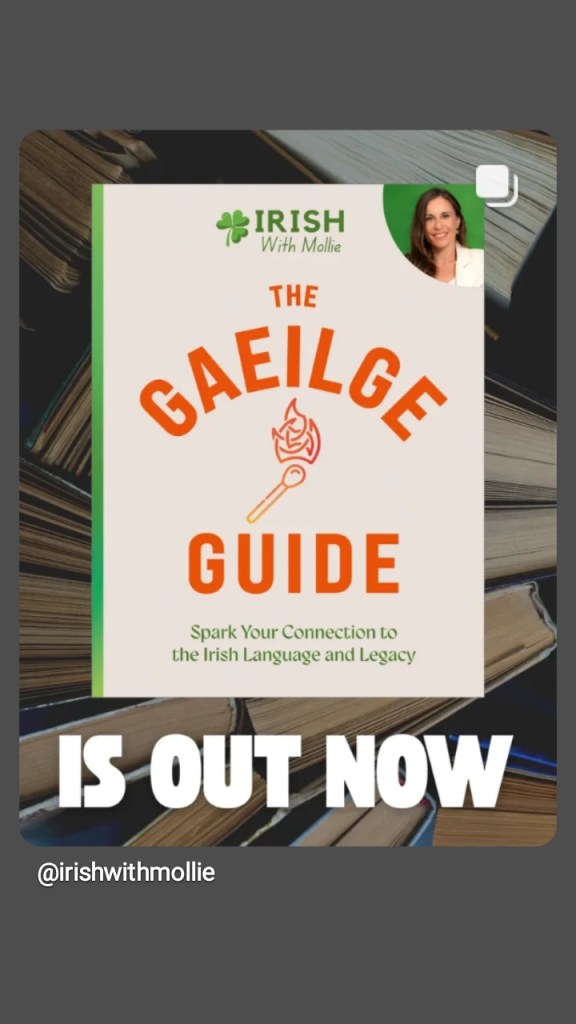
Since I recorded my interview with Mollie Guidera last year, she has not stood still! Mollie launched her book, The Gaeilge Guide, in September, and it was nominated for the An Post Irish Book Awards in The Last Word Listener’s Choice category. Mollie has now published 40 episodes of her podcast, and on the likes of TikTok and Instagram, her @IrishWithMollie accounts have about 300,000 followers. Mollie is an educator who has taught Irish (and English) and has designed an online course that she believes is suitable for all kinds of learners. Mollie believes in working towards a bilingual Ireland! Enjoy the interview!
…people can become fluent in Irish much quicker than in English.
Irish Language Matters (ILM): Is there a danger that people can get stuck in learner mode and become dependent on the tutor, their class, and the contacts that they make there – and I do think that’s important and that is part of their real lives and their lived experience – but is there a danger that they don’t get to integrate that part of their lives with their wider social lives?
Mollie: I have always tried to create autonomous learners and I joke that I’m creating a massive community of assistants or teachers. It’s not really a joke because the next step would be an academy of teachers. People are learning very fast and very well, and they’re able to answer each other’s questions. So I don’t actually need to be there as much as I used to because people are just accelerating their progress.
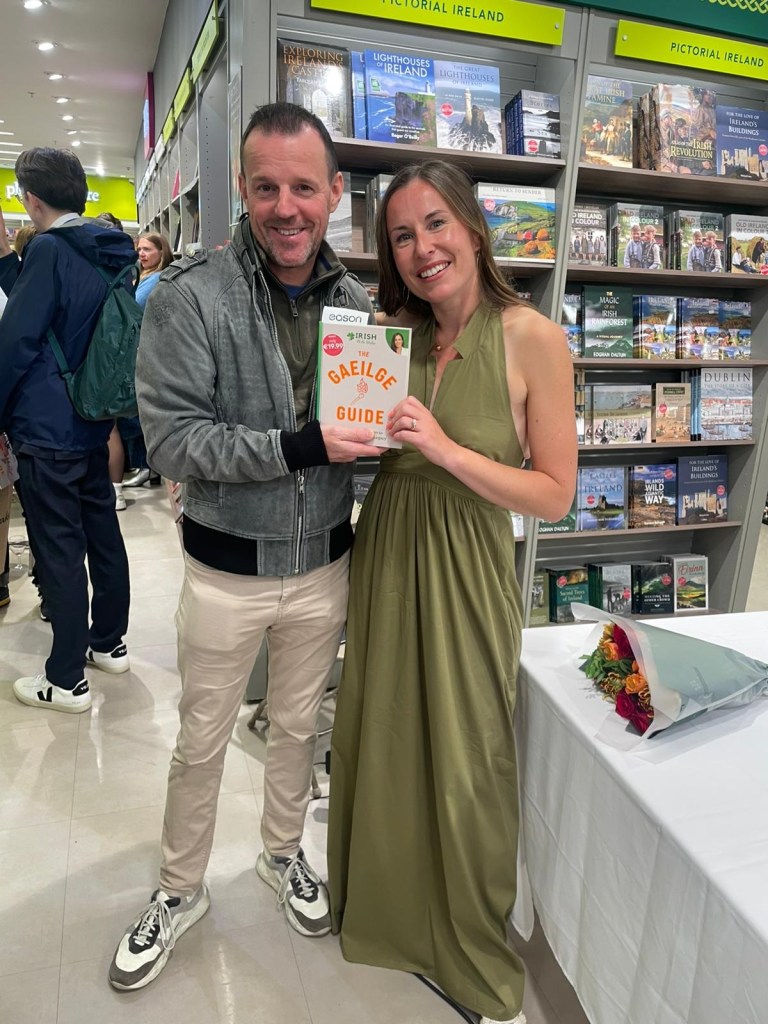
With Mollie at her book launch in Dublin in September 2025
One risk could be because people love it so much. People are really in love with our community and actually falling in love with each other sometimes, and making friends and pen pals and all this. Maybe they’re keeping it a secret from their friends. You know sometimes if you have a hobby, and you’re like “These are my friends from kayaking or whatever, and I don’t want to introduce them to my husband (or whatever), because this is my thing and me time”. But I think it’s great that people are setting up their own Ciorcal Comhrás. They’re bringing it into the wider world. They’re setting up merchandise companies, they’re becoming teachers, using more Irish in the workplace or with their families. I think it’s like buds blossoming. One of the questions at the start was “Is this too much online? Is it really having an impact in the real world?” And it is. You have these walking clubs in Irish. People say, “Because of your course, I felt really confident and I was able to use my Irish with other people. Now I have new friends.” I love to hear that.
ILM: Have people really met partners at the classes?
Mollie: Yep! A few couples. I don’t think we’ve had our first Irish With Mollie baby yet, but a few people have fallen in love!
It’s not just ‘Mave’, like ‘pave’ (a street) in English. It’s Méadhbh, and you can hear those inflections.
@irishwithmollie aka Mollie Guidera
ILM: Do you think Irish people that don’t speak Irish – especially critics – and I think it’s less prevalent in mainstream discourse and social circles, you don’t see the kind of toxic, aggressive, anti-Irish rants that you might find on microblogging sites. But for people who are critical of Irish maybe, do you think they’re in a position to assess what they’re missing out on if they don’t have a knowledge of the language, the placenames, the names, the songs, the stories, the literature, and all the social experience that goes with that? You know, if I say, “I never spoke a word of Irish in my life and it didn’t do me any harm”? I sometimes think of someone who years ago said to me, “My Dad used to beat me as a kid, but it didn’t do me any harm”. Are you really in a position to assess that, you know?
Mollie: My God! Yeah, I think it comes from a deeply colonised mindset and an insecurity – a major insecurity – also a disobedience, a wilful luxuriating in ignorance; a wanting to not learn you know? And I think maybe we all have it. I know that sounded very judgemental. Like, I mean, I don’t really like golf and I wouldn’t really be interested in it. Maybe there are major fans and they’re like, “You have to try this, it’s life changing!” I would actually be open to going on a course and spending some time. I’m pretty open to those things, but I think people are pretty closed-minded about the language and I think it might stem from personal experience. Yeah, maybe having failed at school, or hated their teacher, or they really believed it was a waste of their time, or they had a negative experience with the community or some speakers. But I don’t think they’re in a healthy position to assess the value of the language, and I hope that’s changing and I think it is because we are seeing a huge cultural shift, and a growth in pride and passion and love for the language.
So, someone said to me recently, “I see these girls on TikTok doing ‘Let’s put on my make-up in Irish’ and I feel jealous, but in a good way, like inspiring jealousy like, “I really need to understand that, so I’m learning as much as I can to understand ‘what are they saying?’, ‘why is that funny?'” And these memes or music, like Kneecap has had a great effect in that way. People want to learn the lyrics. They want to know ‘what’s that word?’, ‘why is it pronounced like that?’ People need to catch up with what’s cool. At one stage it definitely wasn’t cool, and I think to distance yourself from that and see it for its integral value is important. So, I think it is changing, and people who used to complain about it are realising it’s not cool to complain about it anymore – it never was but definitely not now.
People say, “Because of your course, I felt really confident and I was able to use my Irish with other people...”
ILM: Yeah, that attitude seemed to get a lot more airtime – particularly in the print media going back maybe 10-15 years ago, but there’s probably less of it now. And obviously, we live in a free society, everyone’s entitled to have their opinion, but I sometimes wonder would people be given airtime if people said that they hated opera music or they hated art, do you know? It’s a bit like saying “I hate oil paintings”, do you know? Like, “I’m anti oil painting”. You’d just be laughed out of town if you said, “I’m anti-oil painting”, or anti Pop music, so the idea that you are against a whole language and everything that entails – to me that’s just bonkers if you look at it critically.
Mollie: Yep. Absolutely. I think it doesn’t deserve that kind of hate. Nothing does, and it makes no sense, like you say.
ILM: I’m with you on the golf by the way! What do you make of it when people say they want Official Irish to be made easier in order for it to be brought into the mainstream – that some of the grammar be rationalised to make it more learnable for the average Joe?
Mollie: Well, I don’t agree with the phonetic spelling of Irish. Some people think that would save time, but actually if I’m to write fáilte phonetically for me, you might not read it fáilte. And then do you make people learn the International Phonetic Alphabet? Like, I don’t think that makes any sense and it reduces the music of the language and then the nuances, and even the meaning. So, I don’t think learning Irish needs to be time consuming if it’s taught very clearly. If it’s taught very clearly and with energy, it’s a very logical, satisfying and consistent language. It is orthographically shallow, meaning the sounds are very consistent. You know, I also taught English for about 12 years and English is highly inconsistent, irregular and annoying to learn and teach and people can become fluent in Irish much quicker than in English. So, I think there are so many misconceptions and mysteries, and to demystify it is so important. Like, when people go “I can’t learn Irish because I have dyslexia.” Well, you learned English. You know? Or “I can learn other languages like French because they make sense” or “Irish isn’t written the way it’s spelled”. It is. And in a name like Méadhbh, you do hear the ‘dh’ and the ‘bh’, beautifully. It’s not just ‘Mave’, like ‘pave’ (a street) in English. It’s Méadhbh, and you can hear those inflections. So, I think it’s a case of loving the challenge and learning to engage with it and embrace the learning curve. People want things to be easy and convenient and comfortable but, come on, if you want to have a ripped body and feel good and do anything good for yourself like eat well and look after yourself, it takes effort and so does learning a language.
ILM: Yeah, 100%. Do you think Irish has more internal consistency than English would have because – you know the way English is like a magpie, it borrows from everywhere.
Mollie: Yeah, I think so. I also think that what people find difficult, it’s just not being explained very well, you know? People go “Oh, when you throw in a ‘h’, why does that happen?” Well, here’s a list of why that happens, and here are the letters it happens to. It’s not completely random – only 9 letters – here’s a mnemonic…Like, mnemonics are great. I think people then realise, “Oh, there’s a reason – there’s a connection with ancient Irish culture. OK, so Irish is not complicated. It’s our relationship with her that’s complicated, and we just haven’t had a meaningful, joyful response to that”.
ILM: That’s lovely, yeah. And I think that once people – as learners – get used to the phonetics and the fadas and the different sounds and all, that there is a lot of repetition and predictability and that in many ways reading Irish is actually predictable and straightforward. To a monolingual English speaker – and unfortunately many of us are when we finish our time in Secondary School – it may appear to be confusing and unpredictable. You see all these stupid memes on social media about Irish given names which are celebrations of ignorance, I think. I find it very frustrating when I hear people taking the piss out of our Gaelic names. They’re very important as part of our heritage.
I think if it’s taught in a good way, highlighting the beauty and relevance and wisdom of it, people will fall in love with it and want to protect it and want to speak it.
ILM: Can I ask you, in relation to the required subject at school…on the one hand people like Brian Stowell who was a key member of the Manx language revival in the Isle of Man, he felt that compulsion was the enemy and if you allowed kids to choose the Manx language, that they would be committed to that, and therefore you get a cohort of students that are motivated and in a much more positive environment. I can completely see why that makes sense. On the other hand, you have people involved in other language movements, and they say, “We envy what you do in Ireland” because, while the competence achieved at school might be low level, it’s widespread, and so many people in Irish society have a basic knowledge of Irish – they know it exists. So, these are two competing mindsets when it comes to the required element at school. Do you have an opinion on any of that?
Mollie: I don’t think there’s a…you know “Here’s the solution and this is definitely going to work”, but I agree with you, I think having it widespread, all the signs in Irish, having it in every school, putting an emphasis on it in Primary School is really great. I think it’s in Quebec with French that they just assume, “We’re bilingual, and we do things in French as well”. And whether you have any different learning need or any reason – maybe you just moved to Quebec aged 12 – you’re still going to learn French, and it’s going to be a fun and community language and loads of opportunities to use it and it’s taught very well. And people accept it.
Moving away from a colonised mindset
I think there’s such resistance to Irish because a lot of people don’t use it in their daily lives, so they don’t see the point or the value in it. I think if it’s taught in a good way, highlighting the beauty and relevance and wisdom of it, people will fall in love with it and want to protect it and want to speak it. So, I think that’s what should really happen. I think it is happening, and people are realising things about their own language that they never knew. People are like “Wow, that’s actually pretty cool!” They don’t know that Irish is interesting or beautiful or sounds nice, because they’re so brainwashed into thinking it’s backwards, and I think that the further we get away from a colonised mindset…the Republic is still relatively young and people are finally celebrating and reviving our own culture.
People are realising what’s important
You see people like David Keohan – you know with Celtic Stone Lifting, the GAA handball documentary, people getting more into knitwear. When I was a teenager, we drank blue WKD and watched Home and Away and now, maybe not teenagers – in fact, people are drinking a lot less – but people are drinking more Guinness and wearing Aran knitwear. There’s the hipster movement involved, there’s the pandemic influence – people realising what’s important – and I think a pride that’s growing there. But yeah, in terms of fostering a healthy attitude towards the language, I think reducing the stress…also the exam being so terrifying and so scripted really isn’t conducive to loving the language. You know, having to write an essay about social problems, that’s not what an 18-year-old wants to talk about and they could really do a better job if they just think about it.
Preparing students for connection
I remember preparing a student for the exam, and I was just interested like, “Oh, what did you do yesterday? And how did you make that?” and whatever, and they were like “Oh, is that question going to come up?” And I said, “I don’t know.” I think they follow a script, and this is two people having a normal conversation which is not what they are prepared for, which is very sad. So, I think if you’re preparing students for connection, that’s the main thing. And I think it can be done. If you look at the Basque Country, or even the revival of Hebrew, the revival of the Māori language in New Zealand – the different native American languages as well.
I don’t think this is a wave. I think this is a flood at the moment. I think waves have come and gone in the past but this is just gaining momentum.
ILM: I would be very dubious about the certain figures that are out there. The truer statistic might be Gaeltacht speaker numbers, as opposed to overall Irish speaker numbers. The reason I say that Mollie is that I’ve met people over the years who would have much better Irish than me, and their personal assessment (of their ability) is that they can’t speak a word of Irish. And then I’ve met people that literally can’t speak a word of Irish, and they say that they can speak Irish because they know some Irish, or they remember some Irish words. So, I think people are pretty bad judges at their own ability at language. My question is, with this positive wave of Irish language art, creativity, culture and passion towards the language in recent years, do you think that we are seeing a quantifiable uplift in usage in the community, or will that become apparent in the future or, as Bláthnaid Ní Chofaigh suggested recently in an interview, is this just a wave and we need the wave to fall away before we can tell what we’re left with?
…it’s a verb-first language and only 6.7% of the world’s languages are verb-first, that’s why we say, “Says she to me”, “Says I to her”.
Mollie: I don’t think this is a wave. I think this is a flood at the moment. I think waves have come and gone in the past but this is just gaining momentum. I think the world – not just Ireland – needs Irish. It is so breathtakingly beautiful. Loads of people you meet are just enamoured with it. People love the sound of Irish, the concept of the words and the diaspora is absolutely massive and I think it’s a beautiful way for people to connect and feel this resonance with their homeland. Irish people have traditionally been pretty mean to Irish American’s for example, not believing that they’re Irish; who are kind of mocking them for being so enthusiastic but I think what we need is enthusiasm and I like how I can straddle the different markets. Some people go “Oh, is this geared towards Americans?” No. I’ve maybe 35% of my students are Irish people living in Ireland and they connect very well with it but then they don’t know what level they’re at. They think they’re intermediate and then they realise “I have to go right back to the beginning because I don’t know what an urú is and I don’t really know what a masculine noun is.” It sounds like the nitty-gritty, and some people say, ” Just talk”, but people don’t feel comfortable just talking, they don’t want to make mistakes. They want to understand why is it like this? And why do we speak the way we do in Ireland? It’s all connected and it’s very interesting to know that because it’s a verb-first language and only 6.7% of the world’s languages are verb-first, that’s why we say, “Says she to me”, “Says I to her”. People love that. They’re like “Ah, so that’s why my Grandmother said ‘I’m only after doing this”, you know? They love these connections to syntax.
In terms of using it in the public sphere I think it is happening that you see more yoga classes in Irish, cookery classes in Irish around Ireland, different things happening and people actually committing to it. I don’t think it’s something that people are going to let go after it fades away. I don’t think it’s a fad.
ILM: I would be thrilled to think that that’s the case, and I do hope and believe that it is the case. Sin é. Tá gach ceist curtha agam. Táim fíorbhuíoch díot as do ama agus do phaisean don teanga chomh maith!
Imbolc – St. Brigid’s Day – Lá Fhéile Bríde – 1 February
‘Anois teacht an earraigh, Beidh an lá ag dul chun síneadh, ‘S tar éis na Féile Bríde, Ardóidh mé mo sheol.’
– Antaine Raiftearaí (1779 – 1835)
Introduction
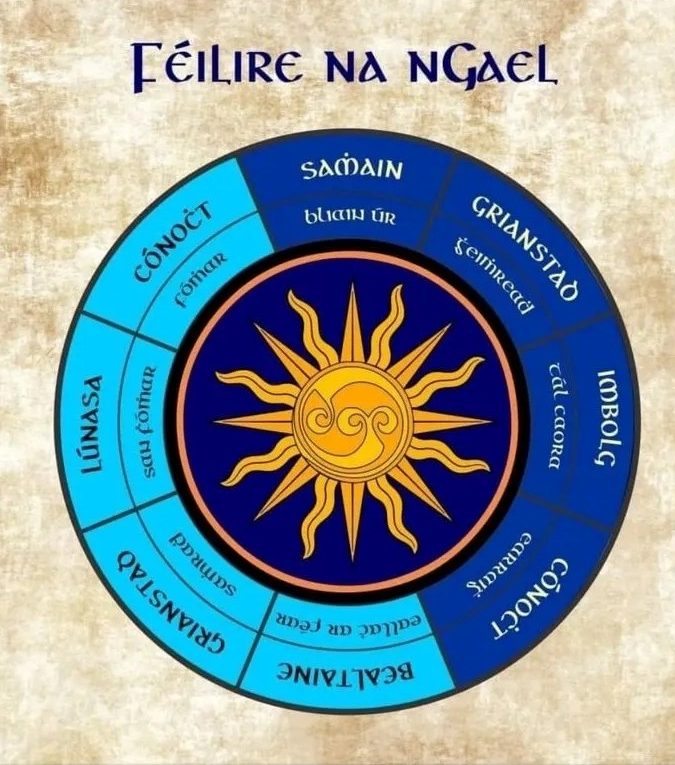
The St. Brigid’s cross has been made, and homes were cleaned in preparation for her arrival, ribbons or strips of cloth tied to the sceach outside. Since 2023, Ireland has a Public Holiday to mark St. Brigid’s Day and Imbolc. Imbolc is one of the four main ancient Gaelic festivals: Samhain, Imbolc, Bealtaine and Lúnasa, all of which now have a corresponding Public Holiday. There is an enormous amount of history, tradition and heritage associated with this time of year, so here’s just a taste of that…
Imbolc: A Whisper of Light & Heat to Come
Imbolc signals the time the Cailleach may yield to Brigid, and from wizened spindly fingers, relinquish her wintery hold on the land. Depending on the depth of the winter, the first early signs of spring flora may emerge. Buds are visible on the trees. Daylight has noticeably lengthened since an Nollaig, and Irish people comment on “A grand stretch in the evenings”. Birdsong has become more audible. Cattle and sheep are gestating and there is a promise that all of nature – life itself – will flourish again soon.
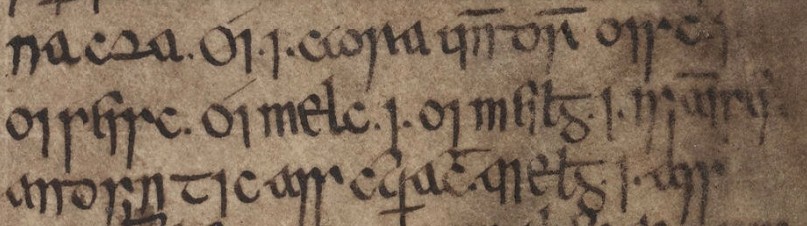
The origins or possible evolution of the word imbolc is not 100% certain, but there are theories. Some believe it comes from Old Irish i mbolg ‘in the belly’, and reflects the pregnancy of cattle and sheep. This is certainly how I have understood it, but this may not be correct. Another idea is that it may come from imb-fholc suggesting a ritual of washing or cleansing. ‘Ewe’s milk’ seems to be the interpretation from an early historical term associated with the festival, Óimelc. This term is over 1,000 years old. More on this below.
Imbolc appears in one of the oldest dictionaries in Europe!
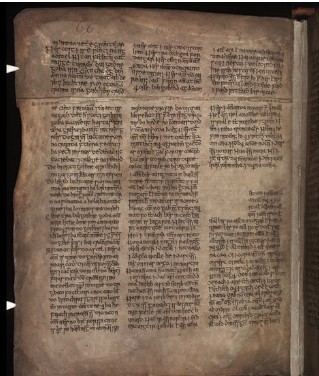
Early written references to the festival go back to Sanas Cormaic, ‘Cormac’s Glossary’. The earliest version of this collection of over 1,400 arcane words has been attributed to Cormac mac Cuilennáin, a Bishop and King of Munster, killed in battle in AD 902. Cormac’s Glossary is written in the vernacular (the plain language of the people) and is possibly the first such dictionary ever written in Europe in any of the non-classical languages. [Remember, for centuries, colonial propagandists said Gaelic culture was in need of civilisation. In fact, Ireland was a beacon and bastion of education during the Dark Ages, and education tourism flourished – but I digress.] Imbolc or something corresponding to it appears in Cormac’s Glossary as Óimelc, ‘Ewe’s milk’.
You might be able to pick out the word Óimelc, ‘Ewe’s Milk’ apparently, to the left of centre in the second line. It took me an hour to find it from the online version of the Yellow Book of Lecan (Leabhar Buidhe Leacáin). It’s on p.70, column 68 at www.isos.dias.ie/TCD/TCD_MS_1318
Brigid, Brigit or Bríd…
Brigid, Brigit, Bríd, Bridget and Brighid are all names associated with the female figures celebrated at the commencement of February. There is the Goddess Brigid, the Saint Brigid, and the Brigid who overlaps both. Brigid can transcend many things including beliefs and she represents different things to different people. It was Irish Christians that first started to write down Irish mythology and folkore. The subsequent history of a patriarchal society was recorded predominantly by males and about males. Brigid, in her various forms, represents something of a rebalancing. For many, she is a feminist icon.
Brigid, Pagan Goddess
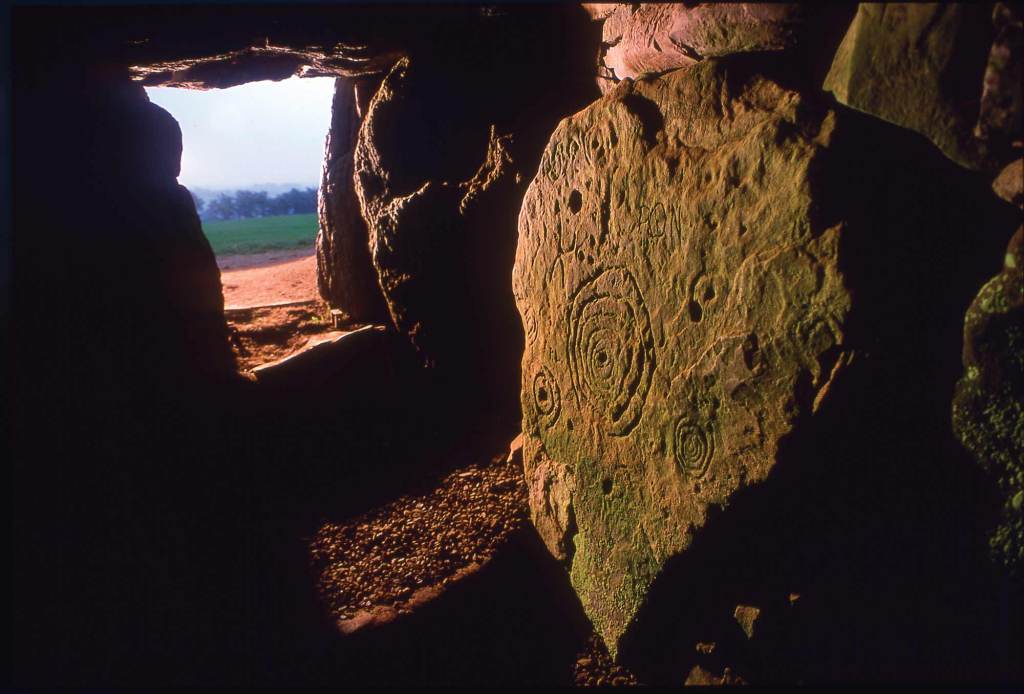
As with the age of Imbolc, it is currently impossible to say how far back worship of Brigid goes. 2,000 years would probably be a conservative estimate. We know that the time of year that Brigid is celebrated corresponded with something that goes back 5,000 years in Ireland. At the sacred Hill of Tara, the Neolithic passage tomb known as the Mound of the Hostages was constructed and aligned to be illuminated by a shaft of light from the rising sun at Imbolc and Samhain. When we mark this time of the year, we do so in the knowledge that this tradition is shared with people who lived in the Neolithic period (New Stone Age); the pre-Christian Pagan Gaelic population; the Christian Gaels; and for many others from different backgrounds who have lived here. Many of our schools do a good job of ensuring the continuation of these traditions, in an inclusive manner.
The morning sun illuminating the passage of the Mound of the Hostages. heritageireland.ie
Brigid was obviously a powerful Goddess in Pagan, pre-Christian Ireland. ‘Brigit’, as she’s referred to in Sanas Cormaic, the deity, was the daughter of The Dagda, who was the chief God of the supernatural race, the Tuatha Dé Danann. Brigit had two sisters, also called Brigit: one a healer, the other a smith. Some have interpreted this as Brigit having been a triple deity. Brigit was said to be adored by poets, a protector, having great respect and influence, and sage-like wisdom. In a marriage of political alliance, intended to create peace between the warring Tuatha Dé Danann and the Fomorians, she married Bres, who was half Fomorian. They had a son, Rúadán.
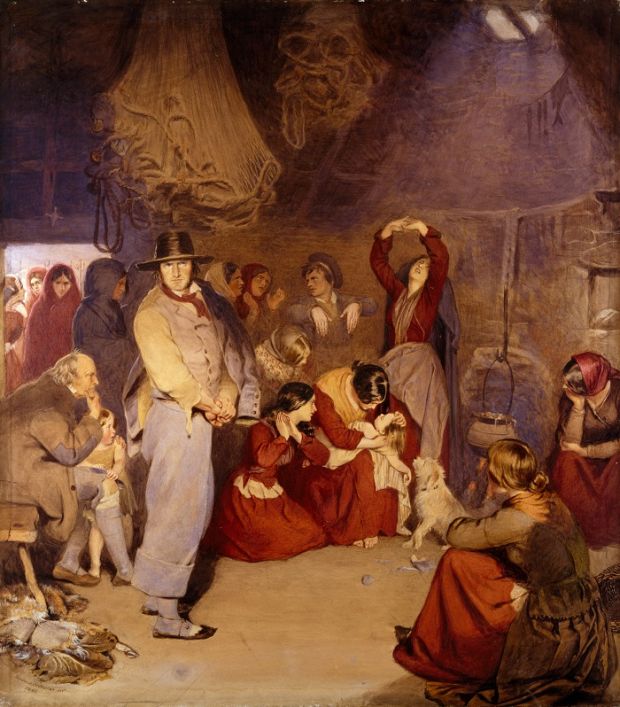
“The Aran Fisherman’s Drowned Child” (1851) by Frederic William Burton depicts keening
Keening
When Rúadán is killed in battle, Brigid is reputed to have invented the Irish tradition of keening. Keening is a sung lament for the dead. Keening (from the Irish ‘caoin’, to cry or mourn) involves the singer, usually a woman, performing a ritual song and fluctuating between notes while singing the same syllable of word [a melisma?]. Some perceive the influence of keening in the styles of two of Ireland’s great singers, Sinéad Ó Connor and Dolores O’Riordan. Brigid is also credited with the invention of a whistle for use in night travel.
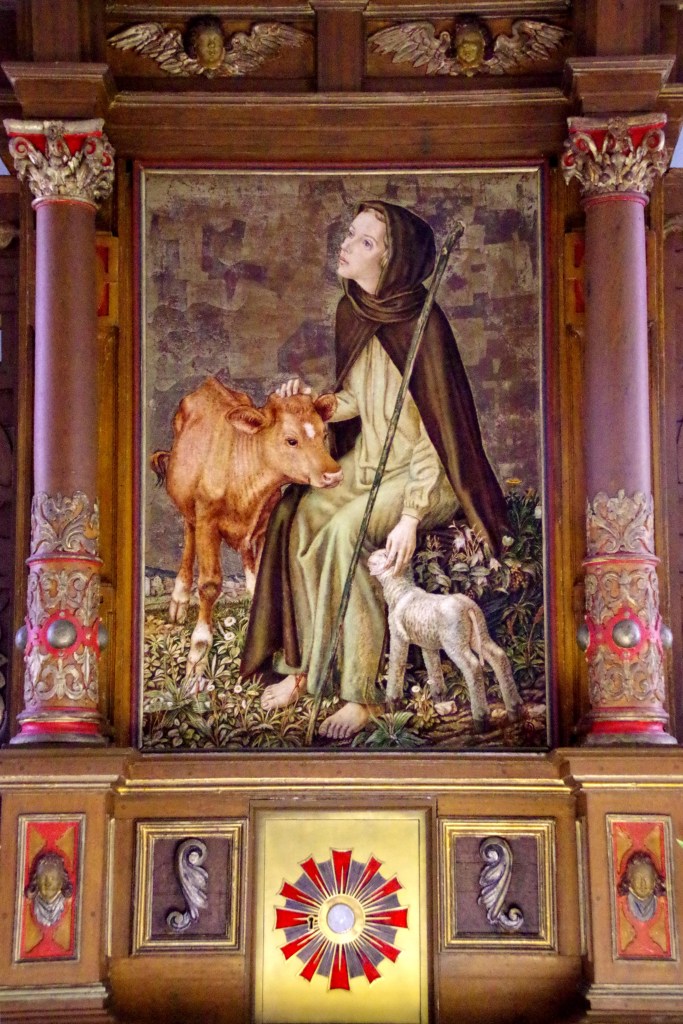
Thomas Hummel – Brigidakapelle (Kronenberg, Germany), baroque high alter with depiction of St. Brigid
Saint Brigid
Naomh Bríd (St. Brigid) or Brigid of Kildare, the historical figure, is reputed to have been born half way through the 5th century, and lived for about 75 years. She is one of the three National Saints, along with St. Patrick and St. Colmcille. Born into slavery and eventually freed, Brigid grew up with farm work. Brigid refused to marry and pursued a spiritual life, often tending to the poor. At some time around 480AD, she is credited with founding monasteries in Kildare, and becoming the first Abbess of Kildare.
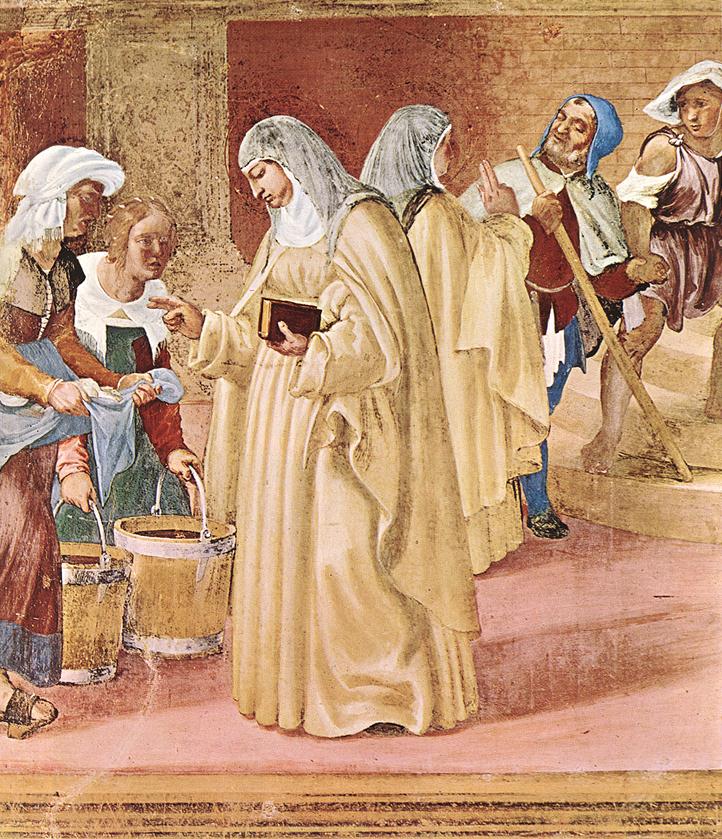
Probably the best known of the stories about Brigid involves her asking the King of Leinster for land to build a convent. When he refuses, she invokes the power of God. She asks if the King will grant her the amount of land that her cloak will cover. The King, finding this amusing, agrees. Miraculously, Brigid’s cloak expands to cover the area of the Curragh in Co. Kildare. The King is cowed, converts to Christianity, and agrees to give Brigid the land she wants.
A fresco by Lorenzo Lotto, 1524. This shows Brigid turning water into beer, miraculously giving site to a blind man.
Legacy
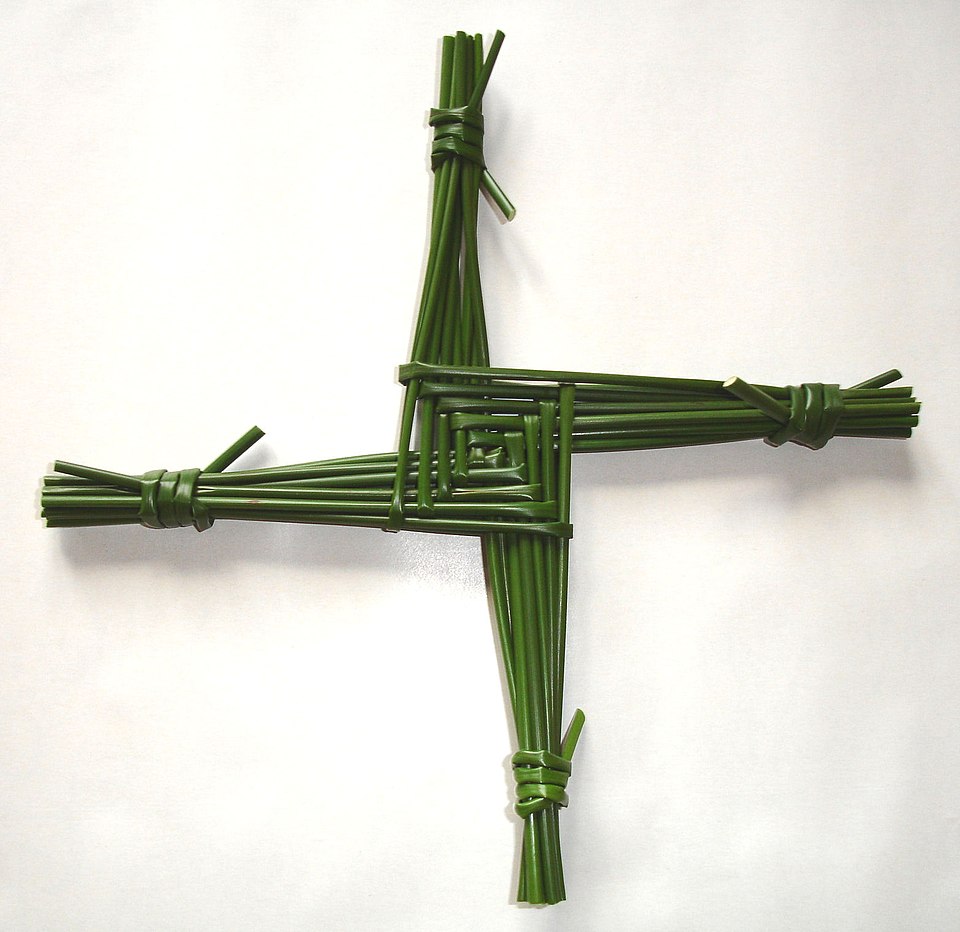
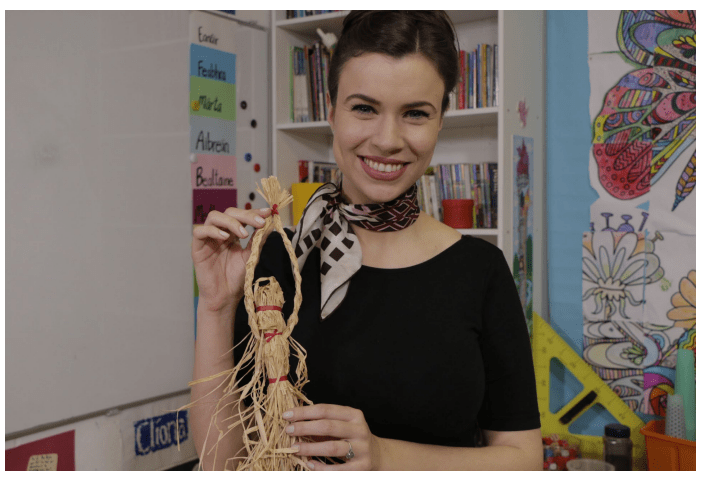
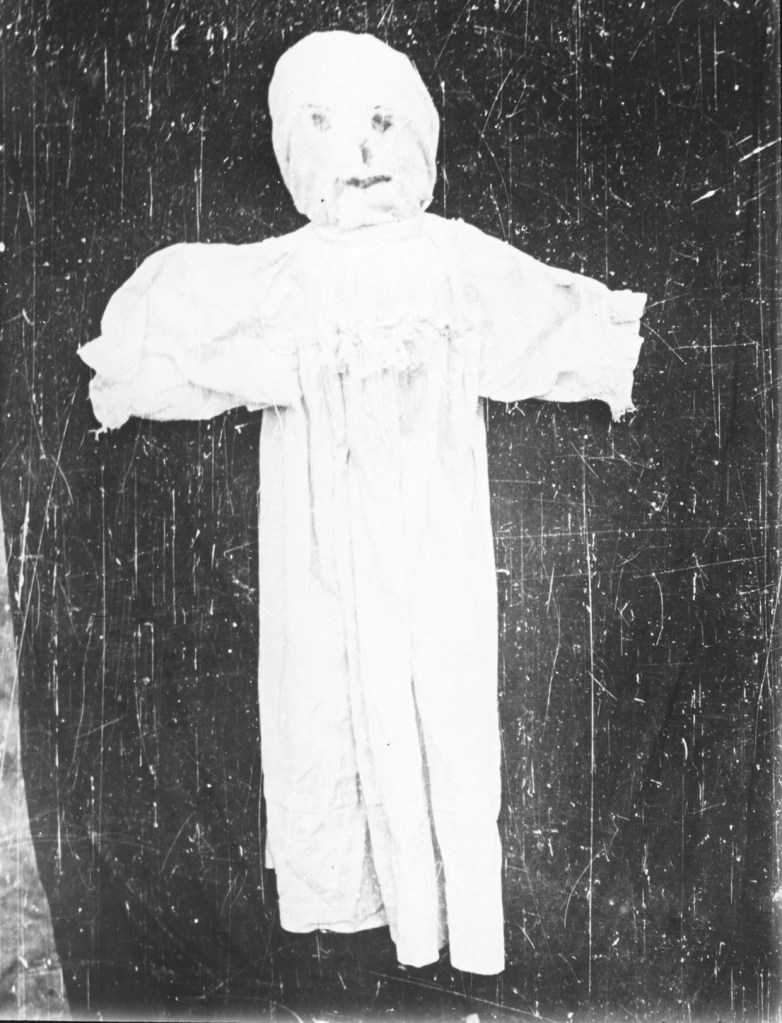
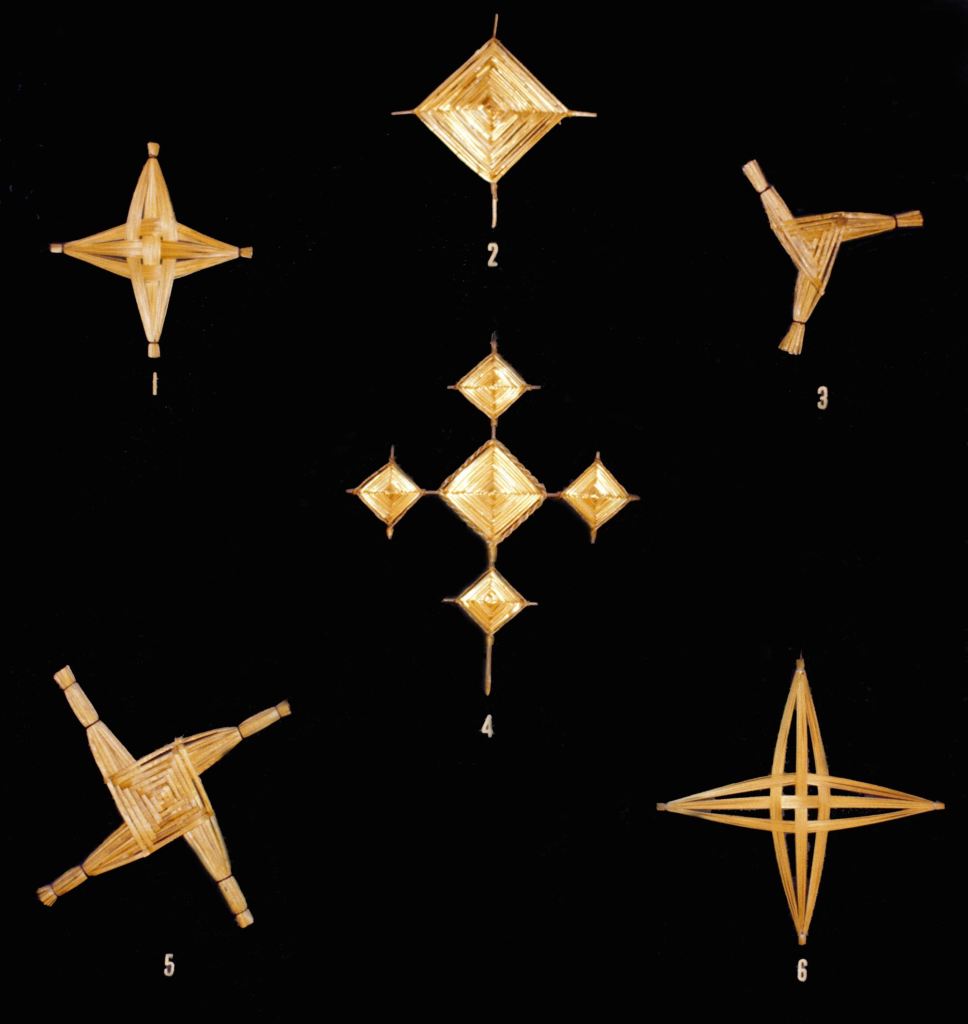
It is still a habit for many families – or children attending primary schools – in Ireland to continue the celebration of Brigid. The most common tradition is probably the making of the St. Brigid’s Cross. These crosses used to be put up in the home for a year, and were burned when it was time to create new ones. Another tradition is the making of the Brídeog doll. There are some photographs of different forms of the St. Brigid’s Cross and the Brídeog, below.
One way to estimate the impact and legacy of Brigid is to see the number of placenames and holy wells she is associated with. There are places called Kilbride all over Ireland – Kilbride is a manglicisation of the Irish placename, Cill Bhríde (The Church of Brigid). There are at least 68 Kilbrides recorded on the Irish placename database, logainm.ie, not including other variations. On the Dúchas.ie website (of the National Folklore Collection) versions of her name appear thousands of times – both in English and in Irish.
Conclusion
I will conclude with a simple quote from a child who contributed to the National Folklore Schools Collection in the 1930s, Máire Ní Dhonnabháin, Co. Waterford. In this quote we see continued associations with Brigid and kindness, caring for the poor, and providing them with sustenance – a noble concept 1,500 years ago, and still today, “Bhí Naomh Bríd an-mhaith dos na daoine bochta. Bhíodh sí ag déanamh im.” (‘Saint Brigid was very good to the poor. She used to make butter.’)
Happy St. Brigid’s Day/Imbolc to all!
If you enjoyed this article on the origins and traditions associated with St. Brigid’s Day and Imbolc, please share it on social media, or follow me on social media: IrishLanguageMatters on Instagram and Threads, @derekholly7.bsky.social on Bluesky, @DerekHolly7 on X. Go raibh maith agat!
If you wish to give something small towards the cost of running the site, you can buy me a coffee – go raibh maith agat!
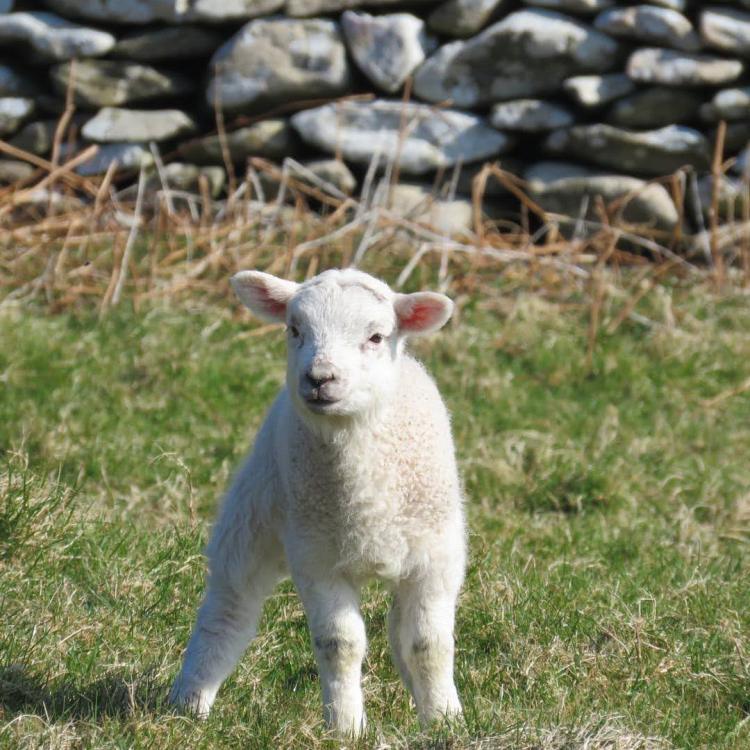
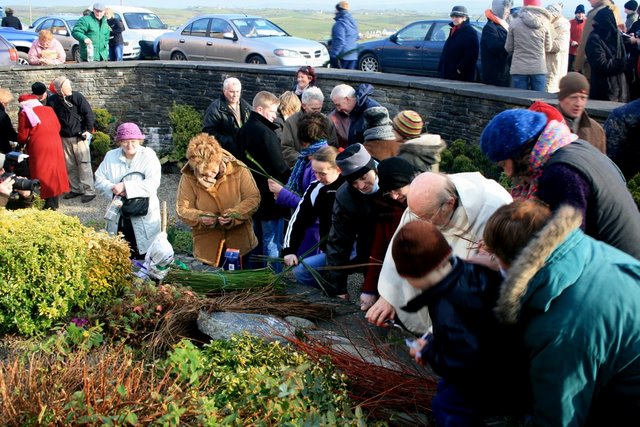
Múintoeir Clíona from RTÉ with a Brídeog dollA Brídeog is a doll or effigy of St. Brigid. Photograph Collection of the National Folklore Collection, Dúchas.ie. (Rachainn craiceáilte da bhfeicfinn é sin, a chairde! I’m not sure if I’ve said that right, but I’d go mad if I saw that! It’s a freaky looking thing)St. Brigid’s crosses. Photograph Collection from the National Folklore Collection, Dúchas.ieWritten in Middle Irish, the Leabhar Buidhe Leacáin ‘Yellow Book of Lecan’ features parts of Cormac’s Glossary and includes an entry for Óimelc – now called ImbolcMaking Brigid’s crosses at a well dedicated to her, Liscannor, Co. ClareThe Gaelic Calendar of Festivals. Image originally from Facebook – I’m happy to credit the source but I haven’t been able to find it1 February, 1983, children visit a holy well associated with St. Brigid and sell crosses, Liscannor, Co. Clare. Photograph Collection of the National Folklore Collection, Dúchas.ie. One of the nice, innocent things about this photo is you can tell the kids are giddy & self-conscious about having their photo taken because there were no camera phones – not a forced duck face in sight.
If you wish to give something small towards the cost of running the site, you can buy me a coffee – go raibh maith agat!
2025 was the year we lost Manchán Magan. It was also the year the North got a Language Commissioner, Kneecap’s star continued to rise, and the Irish language became an issue in the Presidential campaign. There was a large national march in Dublin indicating strong public support for the language. Personally, 2025 was the year I was diagnosed with ADHD, and that I took the TEG level B2 Oral Irish exam.
Kayleigh Trappe was a worthy ambassador for Irish on RTÉAn Chéad Ghlúin Eile, who I saw twice in 2025Best spot in the house, The Cobblestone on St. Patrick’s DayLouise Cantillon, Bláthnaid Ní Chofaigh & Kieran Cuddihy at the Newstalk Studios in JanuaryLe Máire Ní Churraoin agus Shónagh Ní Raghallaigh. Two strong, charismatic women and champions of the Irish language.
January – Eanáir
January started with a #100DaysOfGaeilge challenge – a commitment to use some Irish everyday for 100 days. Kieran Cuddihy, who was participating in #100DaysOfGaeilge, invited me on the Hard Shoulder with Louise Cantillon, and Bláthnaid Ní Chofaigh who wouldn’t let go of the mic 😉
February – Feabhra
Kneecap followed up numerous other awards – including at the Sundance Film Festival – with Rich Peppiatt winning a Bafta for their film, ‘Kneecap’. The #100DaysofGaeilge challenge continued. I published a piece on Colette Nelson who is raising her family through Irish and whose family spent a year on Inis Meáin. I published Part 1 of my interview with Mollie Guidera (@IrishWithMollie) who has been such a huge presence with her social media and Irish language courses. Part 2 of that will be here this February.
March – Márta
I went see An Chéad Ghlúin Eile for the first time in March at the Sugar Club in Dublin. From the Ráth Chairn Gaeltacht, An Chéad Ghlúin eile are sisters Étáin and Máire Ní Churraoin. I’d met Máire before, who performed brilliantly as Bean an Tí at Pobal Gaeilge 15’s show in Ongar, Dublin 15, in 2024. The gig at the Sugar Club was really enjoyable. If you haven’t seen them yet, you’re missing out!
Upfront With Katie Hannon on RTÉ1 television had a live discussion on the Irish language later in the month, which was interesting and demonstrated a clear divide between the audience and a couple of the invited guests on the panel. Kayleigh Trappe spoke very well as an advocate for the language. There was huge positivity for the language in the audience. I was sitting next to Kayleigh’s mam, agus bhí sí go hálainn! (and she was lovely!).
I published a piece on St. Patrick’s Day and I actually had arguably the best spot in Dublin for the afternoon at the trad session in the Cobblestone Pub. I felt like I spoke Irish all afternoon there – there were loads of Irish speakers about!
One of my kids performed with Cór Náisiúnta na nÓg ‘The National Youth Choir’ at the National Basketball Arena, and I was a suitably proud dad, as I always am.
April – Aibreán
D’fhreastail mé ar ‘An Rí’ le Pádraig Mac Piarais ag Músaem na bPiarsach, Páirc Naomh Éanna.
I attended ‘An Rí’ by Pádraig Pearse at the Pearse Museum, St. Enda’s Park.
May – Bealtaine
Champion of minority languages, Ngũgĩ wa Thiong’o, passed away. He was a world renowned leader in postcolonial theory and referred to Ireland and the Irish language many times. He was particularly interested in how the language and the traditional Gaelic naming system were targeted by the colonial administrators in Ireland. I was delighted back in 2022 when he commented positively on my article on him.
A post I put on social media that got a bit of attention. I suggested we reclaim some of our placenames, the vast majority of which were originally in Irish, and told us something about the people, the history, or the geographic features of the place. I suggested we start with places like Log na Coille, ‘The Hollow in the Woods’, the tallest mountain in Leinster (manglicised as Lugnaquilla). I think Glendalough is also an obvious one as a symbol of Ireland. The Irish is Gleann Dá Loch, ‘the Valley of the Two Lakes’, which is exactly what it is.
June – Meitheamh
Pobal Gaeilge 15, the local Irish group I’m involved in, organised a fantastic Comórtas Peile na Gaelscoileanna (Gaelic Football Competition of the Gaelscoileanna) between Gaelscoil Thulach na nÓg, Scoil Oilibhéir and Gaelscoil an Chuilinn of Dublin 15 and Dunboyne. We had to postpone by a day when a Weather Warning suggested lightening strikes with potential risk to life! The next day, the sun came out, the competition went ahead, the children, the referees, the teachers and the adults all enjoyed the morning as Gaeilge, and ár gcara ‘our friend’ Máire Ní Churraoin kindly presented the medals and trophies for us.
The BBC Censored Kneecap at Glastonbury, apparently for fear of them potentially criticising the dropping of 2,000lb bombs on children in tents.
Pobal Gaeilge 15 were represented at the national march for the Irish language in SeptemberGPO on the day of the marchCiarán Mac Giolla Bhéin, Uachtarán Chonradh na Gaeilge, addresses the crowdKneecap’s rise continues. They sold out the 3Arena 2 nights in a rowA meeting of the Pobal Gaeilge 15 committeePobal Gaeilge 15 organised a Comórtas Peile na Gaelscoileanna between Gaelscoil Thulach na nÓg, Scoil Oilibheir agus Gaelscoil an ChulinnWith Aileen Crossley at the launch of her book, ‘An Áit a n-Eitlaíonn na Madaí Crainn’Inis OírrWith Mollie Guidera aka @IrishWithMollie at the launch of her book, ‘The Gaeilge Guide’In Brussels, I co-presented a series of workshops, and met 5 Irish speakers in the processAn Chéad Ghlúin Eile sold out the Sugar Club twiceDúramar slán le Michael D. Higgins
July – Iúil
BBC Radio 1 caused controversy when they played CMAT’s Euro Country without the opening verse in Irish. You’d think that Irish radio stations would have taken note, but I heard the same thing happen here afterwards.
One of my kids went to the Gaeltacht and had a fantastic experience. For many children, the Gaeltacht experience – where children go to a summer college in an Irish-speaking region for ideally three weeks – is wonderful in their development of language, confidence, sociability and maturity. Regrettably, not every child has this opportunity.
August – Lúnasa
I brought my kids to Delphi in Mayo, and to Inis Oírr, na hOileáin Árann (the Aran Islands). We had a really lovely time agus bhí deiseanna againn ár gcuid Gaeile a úsáid ‘we had opportunities to use our Irish’. I was very proud watching them order food and drinks as Gaeilge because that takes more courage than just chatting to me.
I was diagnosed with ADHD, which helps me understand my language journey in a different way – but I’ll deal with that in a post some other time. It really gives me cause to re-examine my experiences ‘learning’ Irish in school.
September – Meán Fómhair
Up to 20,000 people took to the streets of Dublin for the Mórshiúl Náisiúnta ‘National March’ for the Irish language – a significant indication of public opinion on the language issue, and a wonderful event to be part of. The atmosphere was really great, as it was in Belfast at An Lá Dearg in 2022.
Manchán Magan was a huge inspiration to me – and innumerable others
October – Deireadh Fómhair
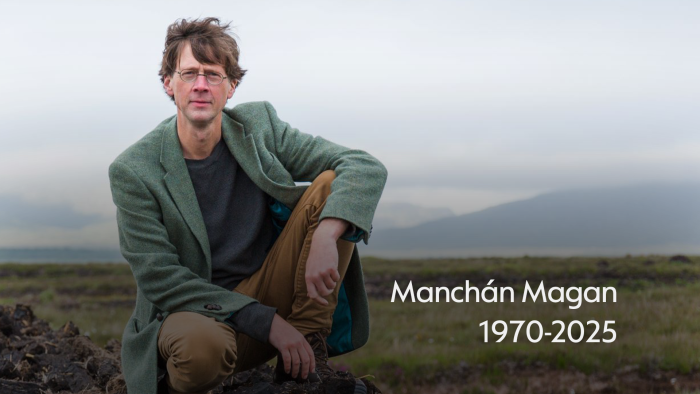
Manchán Magan died on 2 October. A huge inspiration in the areas of language, land and legend; there were tears shed all around the country. I went to his funeral, which was some occasion. I planted some of Manchán’s acorns (there were baskets of acorns and apples from his land for attendees at his funeral), and hopefully they will grow into oak trees. Uisneach was the site of the scattering of his ashes.
Pól Deeds was appointed Irish Language Commissioner for the North – a significant milestone for the Irish language movement following years (decades) of campaigns for Cearta Teanga ‘Language Rights’.
October 2025 saw the Irish language emerge as an issue for the Presidential Election. Irish was regularly raised with the candidates in debates and in interviews. This was the first time I have noticed this level of interest from the media during an election campaign. There is some evidence that within the cohort of younger adults and teenagers, there is significant importance attached to the language as a fountain of culture; a connection between past, present and future; and as part of personal and national identity.
November – Samhain
During November, I was doing a really good Irish language course with Gaelchultúr and their tutor Niall Ó Siadhail, writer, musician and founder of Nuacht Mhall. The TEG Oral exam was creeping up on the horizon in December.
I co-delivered a series of workshops in Brussels and got to use a cúpla focal in most of these. I also had the pleasure of meeting several Irish speakers in Brussels, which is an EU hub with many Irish people living and/or working there.
December – Nollaig
I saw CMAT and Kneecap within a week of each other in the 3 Arena. There were really good gigs. I’m so glad I got to them, with my only regret of 2025 that I didn’t see Fontaines D.C. live. I went to see An Chéad Ghlúin Eile again at The Sugar Club. It was great fun again.
I attended the launch by Uachtarán na hÉireann, Catherine Connolly, of An Foclóir Nua Gaeilge at the CHQ building in Dublin. This is the first Irish – Irish dictionary and adds a fantastic online resources.
I sat the TEG B2 Irish Oral exam. How did I get on? As of 26 January 2026, I haven’t got the result yet. It should be another week before they’re out. For anyone learning Irish, I think the TEG exams – which are aligned with the Common European Framework of Reference for Languages – are one way to tell if you are making progress. They’re also an official certification. There are various exam levels available: A1, A2, B1, B2, and C1. You can opt to just do the Oral exam if spoken Irish is your focus. In my experience, our ability to assess our own proficiency can be way off. Sometimes progress is imperceptible, and it can feel like we are getting nowhere. That said, language learning is not linear and perfection is the enemy – we have to be able to take a risk and get it wrong.
Agus sin é! Athbhlian faoi mhaise doaibh uilig agus ádh mór oraibh ar bhur dturas teanga i 2026. That’s it Happy New Year to all and good luck on your language journeys in 2026.
Next up from me will be a piece on Imbolc – Brigid’s Day – Lá Fheile Bríde. If you like the blog, please leave a comment, like it, share it, share on social media, subscribe free to the mailing list
If you wish to give something small towards the cost of running the site, you can buy me a coffee – go raibh maith agat!
Go raibh maith agaibh!
Inis Oírr leis An bPáipéarKieran Cuddihy took part in #100DaysofGaeilge in 2025Irish With Mollie. Part II of my interview with Mollie will be here in February (2026)Manchán Magan, Ar Dheis De go raibh a anam, with Anthony Murphy of Mythical Ireland (pic le Anthony Murphy)‘An Áit a nEitlíonn na Madaí Crainn’ le Aileen CrossleyIn 2025 the How To Gael podcast continued to grow. The three hosts are independently successful and could easily have chosen to do this all in English, but chose the bilingual format.Micheál Ó Foghil of Coláiste Lurgan. The college did great work for the children again this year and has big plans for the future.CMAT at the 3Arena performed Euro Country is full, with the first verse as Gaeilge, as she intended when she wrote itKneecap onstage at the 3ArenaAg seoladh Foclóir Nua Gaeilge le Catherine Connolly ag labhairt as Gaeilge
Next up from me will be a piece on Imbolc – Brigid’s Day – Lá Fheile Bríde. If you like the blog, please leave a comment, like it, share it, share on social media, If you wish to give something small towards the cost of running the site, you can buy me a coffee – go raibh maith agat!